
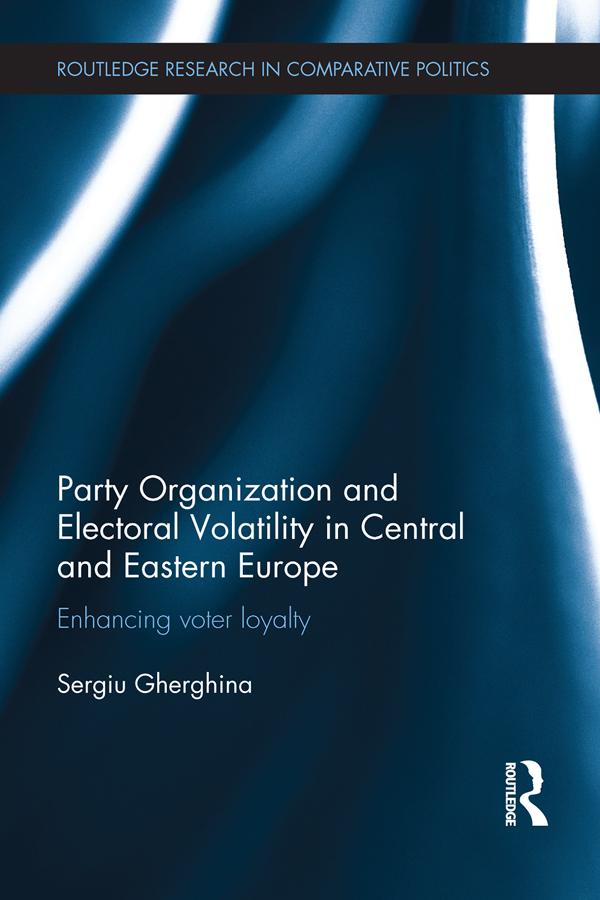
Political parties in post-communist countries have very high levels of electoral volatility. In these environments, political factions fail to establish long-term connections with the electorate and thus regularly rise and fall from the political arena.
This book provides an organizational explanation for the variations in party-level electoral volatility. It looks comparatively at 29 political parties in six Central and Eastern European democracies between 1990 and 2008 to examine how political parties can influence their electoral environment. Using empirical evidence, Gherghina tests the effect of candidate selection procedures, membership organizations, and re-nomination of incumbent MPs on voters’ loyalty, and in doing so, demonstrates how party organization greatly affects electoral stability.
Including case studies from Bulgaria, Czech Republic, Hungary, Poland, Romania, and Slovakia this book will be of interest to students and scholars of comparative politics, party politics, democratization, elections, and Central and Eastern European politics.
Pay easily by card, Klarna, Apple Pay or Google Pay. Not happy? You always have a 14-day money-back guarantee. Read more in our terms. If you have any questions, email us at hello@memmo.org.
Memmo makes studying easier – wherever you are in the world. We bring your course books and smart study tools together in one place: summaries, quizzes, podcasts and flashcards. Plus Ted, your study buddy who answers anything you wonder. Over 50,000 students already study here – built to help you learn faster and stress less.