
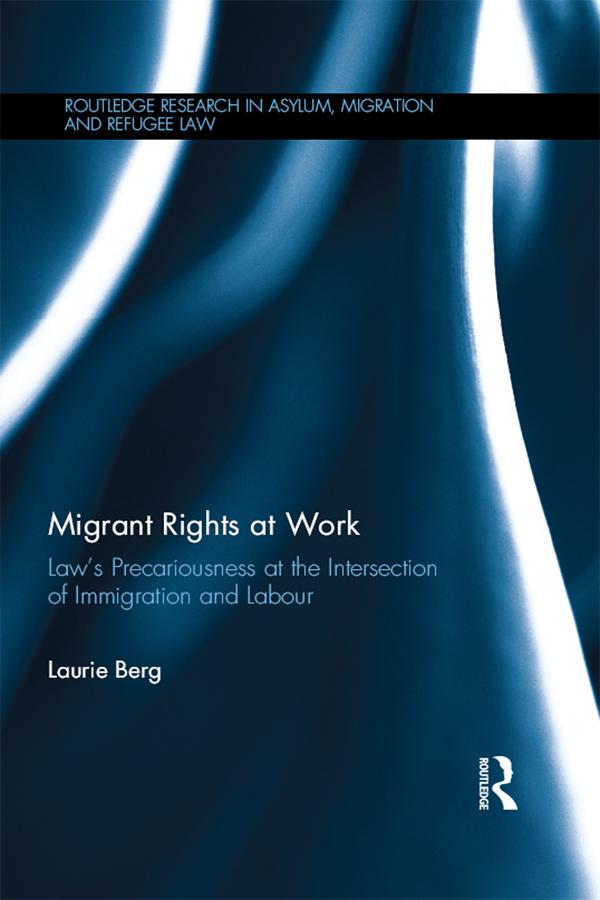
Public debates about the terms of membership and inclusion have intensified as developed economies increasingly rely on temporary migrant labour. While most agree that temporary migrant workers are entitled to the general protection of employment laws, temporary migrants have, by definition, restricted rights to residence, full social protections and often to occupational and geographic mobility. This book raises important ethical questions about the differential treatment of temporary and unauthorised migrant workers, and permanent residents, and where the line should be drawn between exploitation and legitimate employment.
Taking the regulatory reforms of Australia as a key case study, Laurie Berg explores how the influence of immigration law extends beyond its functions in regulating admission to and exclusion from a country. Berg examines the ways in which immigration law and enforcement reconfigure the relationships between migrant workers and employers, producing uncertain and coercive working conditions. In presenting an analytical approach to issues of temporary labour migration, the book develops a unique theoretical framework, contending that the concept of precariousness is a more fruitful way than equality or vulnerability to evaluate and address issues of temporary migrant labour.
The book will be of great interest to scholars and practitioners of immigration law and employment law and policy.
Pay easily by card, Klarna, Apple Pay or Google Pay. Not happy? You always have a 14-day money-back guarantee. Read more in our terms. If you have any questions, email us at hello@memmo.org.
Memmo makes studying easier – wherever you are in the world. We bring your course books and smart study tools together in one place: summaries, quizzes, podcasts and flashcards. Plus Ted, your study buddy who answers anything you wonder. Over 50,000 students already study here – built to help you learn faster and stress less.