
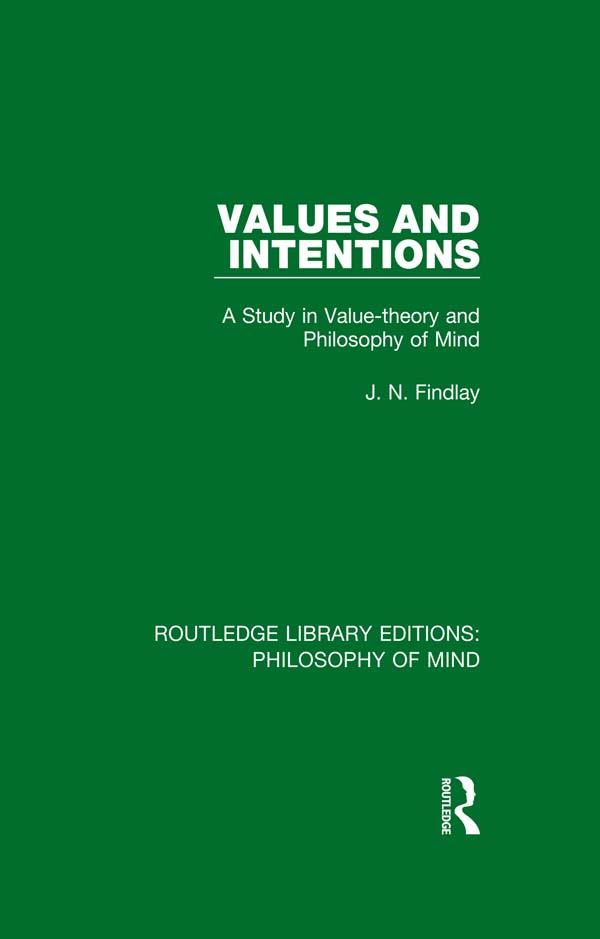
Professor Findlay in this book, originally published in 1961, set out to justify, and to some extent carry out, a ‘material value-ethic’, ie. A systematic setting forth of the ends of rational action.
The book is in the tradition of Moore, Rashfall, Ross, Scheler and Hartmann though it avoids altogether dogmatic intuitive methods. It argues that an organised framework of ends of action follows from the attitude underlying our moral pronouncements, and that this framework, while allowing personal elaboration, is not a matter for individual decision. The relations connecting our fundamental value-judgements with one another, and the frames of mind behind them, are not rigorously deductive but are sufficiently compelling to be called logical. Something of a ‘transcendental deduction’ of a well-ordered family for our basic heads of valuation is both possible and necessary. The work is further critical of the notion of obligation which has been extended far beyond legal contracts and understandings. The book also contains a chapter on religion.
Pay easily by card, Klarna, Apple Pay or Google Pay. Not happy? You always have a 14-day money-back guarantee. Read more in our terms. If you have any questions, email us at hello@memmo.org.
Memmo makes studying easier – wherever you are in the world. We bring your course books and smart study tools together in one place: summaries, quizzes, podcasts and flashcards. Plus Ted, your study buddy who answers anything you wonder. Over 50,000 students already study here – built to help you learn faster and stress less.