
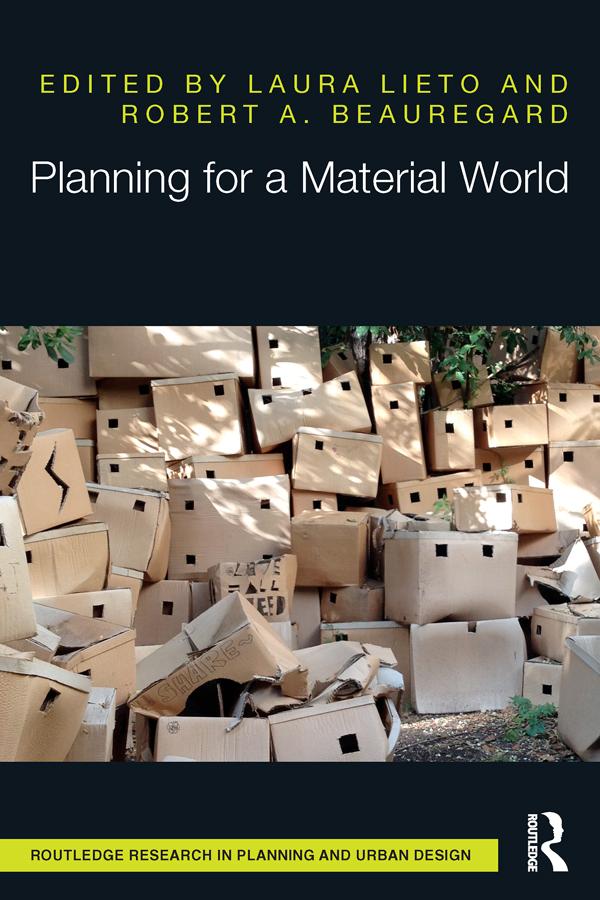
Today, urban scholars think of cities and regions as evolving through networks of human associations, technologies, and natural ecologies. This being the case, planners are faced with the task of navigating a profoundly material world. Planning with and for humans alone is unacceptable: in the unfolding of urban processes, non-human things cannot be ignored. This inclusive vision has consequences for how planners envision the connections among norms, technologies and life-worlds as well as how they design and implement their plans.
The contributors to this volume utilize a variety of examples – ecologically-sensitive, regional planning in Naples (Italy); congestion pricing in New York City; and public participation in Europe, among others – to explore how planners engage a heterogeneous and restless world. Inspired by assemblage thinking and actor-network theory, each chapter draws on this "new materialism" to acknowledge, in quite pragmatic ways, that spatial politics is a process of becoming that is inseparable from the materiality of urban practices.
Pay easily by card, Klarna, Apple Pay or Google Pay. Not happy? You always have a 14-day money-back guarantee. Read more in our terms. If you have any questions, email us at hello@memmo.org.
Memmo makes studying easier – wherever you are in the world. We bring your course books and smart study tools together in one place: summaries, quizzes, podcasts and flashcards. Plus Ted, your study buddy who answers anything you wonder. Over 75,000 students already study here – built to help you learn faster and stress less.