
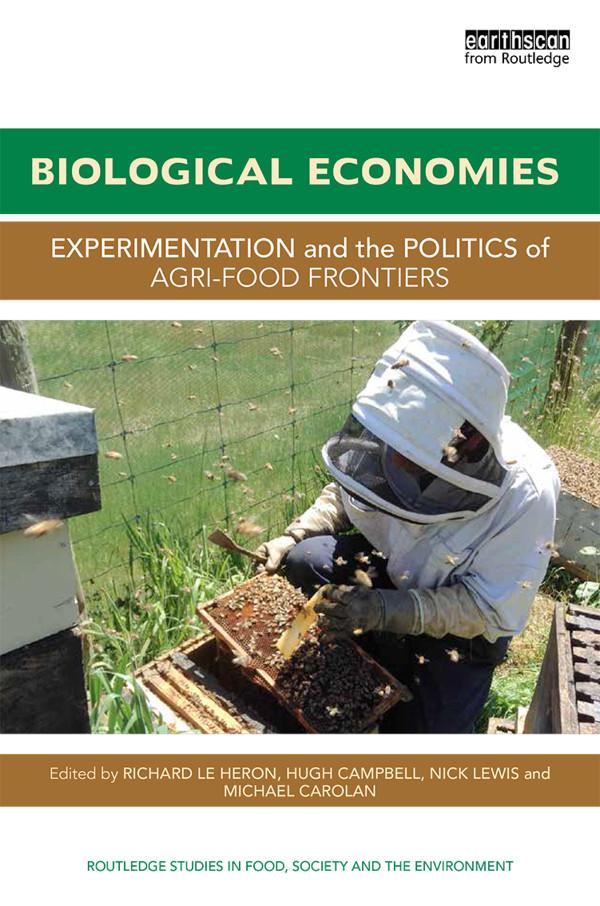
Recent agri-food studies, including commodity systems, the political economy of agriculture, regional development, and wider examinations of the rural dimension in economic geography and rural sociology have been confronted by three challenges. These can be summarized as: ‘more than human’ approaches to economic life; a ‘post-structural political economy’ of food and agriculture; and calls for more ‘enactive’, performative research approaches.
This volume describes the genealogy of such approaches, drawing on the reflective insights of more than five years of international engagement and research. It demonstrates the kinds of new work being generated under these approaches and provides a means for exploring how they should be all understood as part of the same broader need to review theory and methods in the study of food, agriculture, rural development and economic geography. This radical collective approach is elaborated as the Biological Economies approach. The authors break out from traditional categories of analysis, reconceptualising materialities, and reframing economic assemblages as biological economies, based on the notion of all research being enactive or performative.
Pay easily by card, Klarna, Apple Pay or Google Pay. Not happy? You always have a 14-day money-back guarantee. Read more in our terms. If you have any questions, email us at hello@memmo.org.
Memmo makes studying easier – wherever you are in the world. We bring your course books and smart study tools together in one place: summaries, quizzes, podcasts and flashcards. Plus Ted, your study buddy who answers anything you wonder. Over 50,000 students already study here – built to help you learn faster and stress less.