
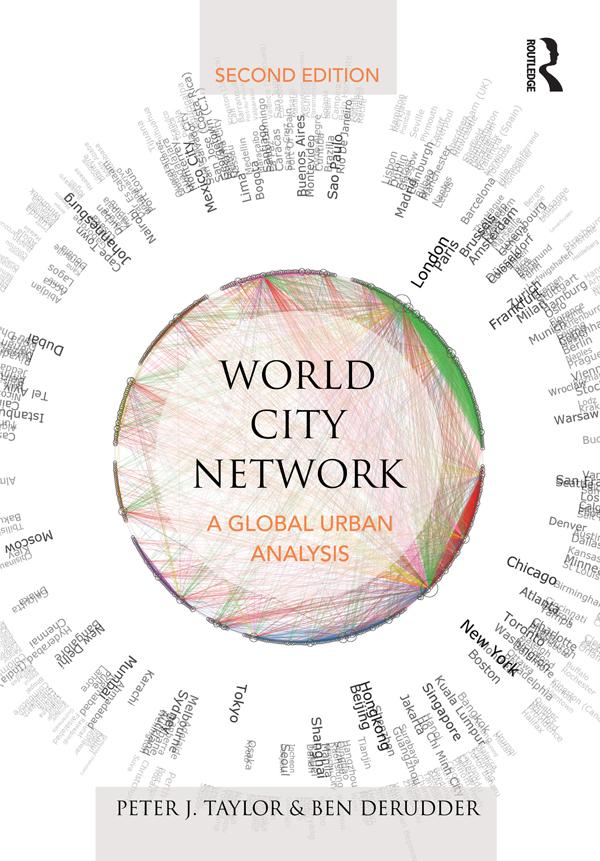
With the advent of multinational corporations, the traditional urban service function has 'gone global'. In order to provide services to globalizing corporate clients, the offices of major financial and business service firms across the world have generated networks of work. It is the myriad of flows between office towers in different metropolitan centres that has produced a world city network.
Taylor and Derudder's unique and illuminating book provides both an update and a substantial revision of the first edition that was published in 2004. It provides a comprehensive and systematic description and analysis of the world city network as the 'skeleton' upon which contemporary globalization has been built. Through an analysis of the intra-company flows of 175 leading global service firms across 526 cities in 2012, this book assesses cities in terms of their overall network connectivity, the regional configurations they form, and their changing position in the period 2000-12. Results are used to reflect on cities and city/state relations in the context of the global ecological and economic crisis.
Written by two of the foremost authorities on the subject, this book provides a much-needed mapping of the connecting relationships between world cities, and will be a valuable resource for students of urban studies, geography, sociology and planning.
Pay easily by card, Klarna, Apple Pay or Google Pay. Not happy? You always have a 14-day money-back guarantee. Read more in our terms. If you have any questions, email us at hello@memmo.org.
Memmo makes studying easier – wherever you are in the world. We bring your course books and smart study tools together in one place: summaries, quizzes, podcasts and flashcards. Plus Ted, your study buddy who answers anything you wonder. Over 75,000 students already study here – built to help you learn faster and stress less.