
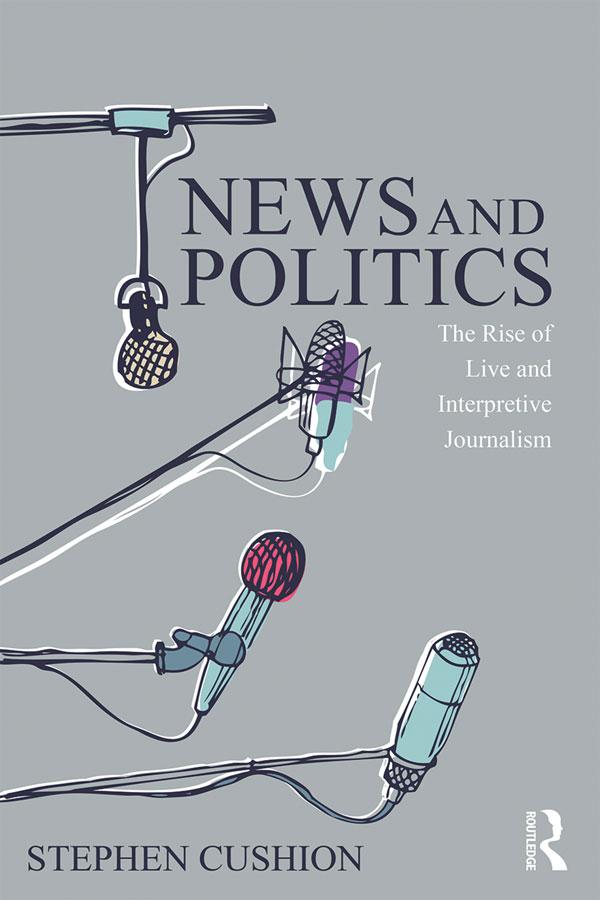
News and Politics critically examines television news bulletins – still the primary source of information for most people – and asks whether the wider pace and immediacy of 24-hour news culture has influenced their format and style over time. Drawing on the concepts of mediatization and journalistic interventionism, Stephen Cushion empirically traces the shift from edited to live reporting from a cross-national perspective, focussing on the two-way convention in political coverage and the more interpretive approach to journalism it promotes.
Challenging prevailing academic wisdom, Cushion argues that the mediatization of news does not necessarily reflect a commercial logic or a lowering of journalism standards. In particular, the rise of live two-ways can potentially enhance viewers’ understanding of public affairs – moving reporters beyond their visual backdrops and reliance on political soundbites – by asking journalists to scrutinize the actions of political elites, interpret competing source claims and to explain the broader context to everyday stories. Considering the future of 24-hour news, a final discussion asks whether new content and social media platforms – including Twitter and Buzzfeed – enhance or weaken democratic culture.
This timely analysis of News and Politics is ideal for students of political communication and journalism studies, as well as communication studies, media studies, and political science.
Pay easily by card, Klarna, Apple Pay or Google Pay. Not happy? You always have a 14-day money-back guarantee. Read more in our terms. If you have any questions, email us at hello@memmo.org.
Memmo makes studying easier – wherever you are in the world. We bring your course books and smart study tools together in one place: summaries, quizzes, podcasts and flashcards. Plus Ted, your study buddy who answers anything you wonder. Over 75,000 students already study here – built to help you learn faster and stress less.