
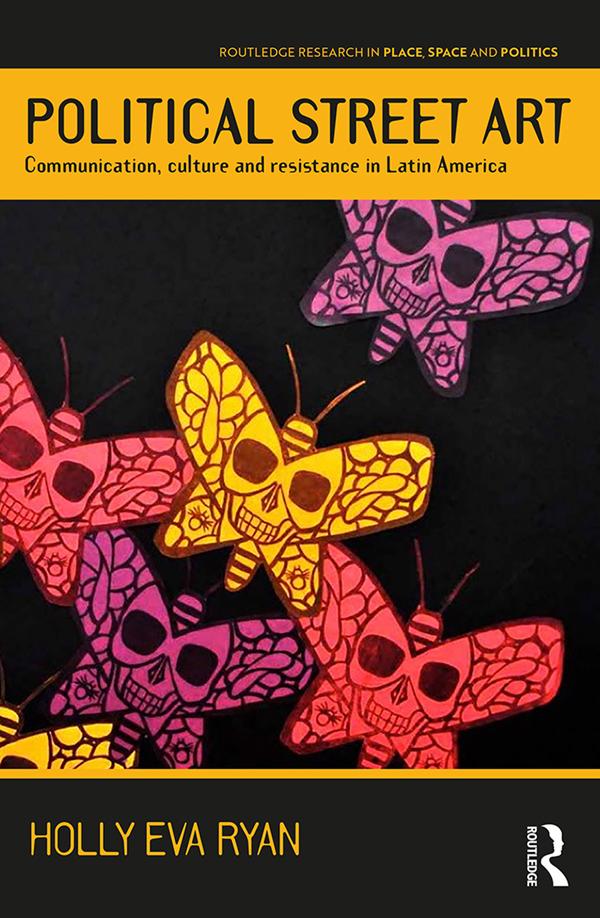
Recent global events, including the ‘Arab Spring’ uprisings, Occupy movements and anti-austerity protests across Europe have renewed scholarly and public interest in collective action, protest strategies and activist subcultures. We know that social movements do not just contest and politicise culture, they create it too. However, scholars working within international politics and social movement studies have been relatively inattentive to the manifold political mediations of graffiti, muralism, street performance and other street art forms.
Against this backdrop, this book explores the evolving political role of street art in Latin America during the twentieth and early twenty-first centuries. It examines the use, appropriation and reconfiguration of public spaces and political opportunities through street art forms, drawing on empirical work undertaken in Brazil, Bolivia and Argentina. Bringing together a range of insights from social movement studies, aesthetics and anthropology, the book highlights some of the difficulties in theorising and understanding the complex interplay between art and political practice. It seeks to explore 'what art can do' in protest, and in so doing, aims to provide a useful point of reference for students and scholars interested in political communication, culture and resistance.
It will be of interest to students and scholars working in politics, international relations, political and cultural geography, Latin American studies, art, sociology and anthropology.
Pay easily by card, Klarna, Apple Pay or Google Pay. Not happy? You always have a 14-day money-back guarantee. Read more in our terms. If you have any questions, email us at hello@memmo.org.
Memmo makes studying easier – wherever you are in the world. We bring your course books and smart study tools together in one place: summaries, quizzes, podcasts and flashcards. Plus Ted, your study buddy who answers anything you wonder. Over 50,000 students already study here – built to help you learn faster and stress less.