
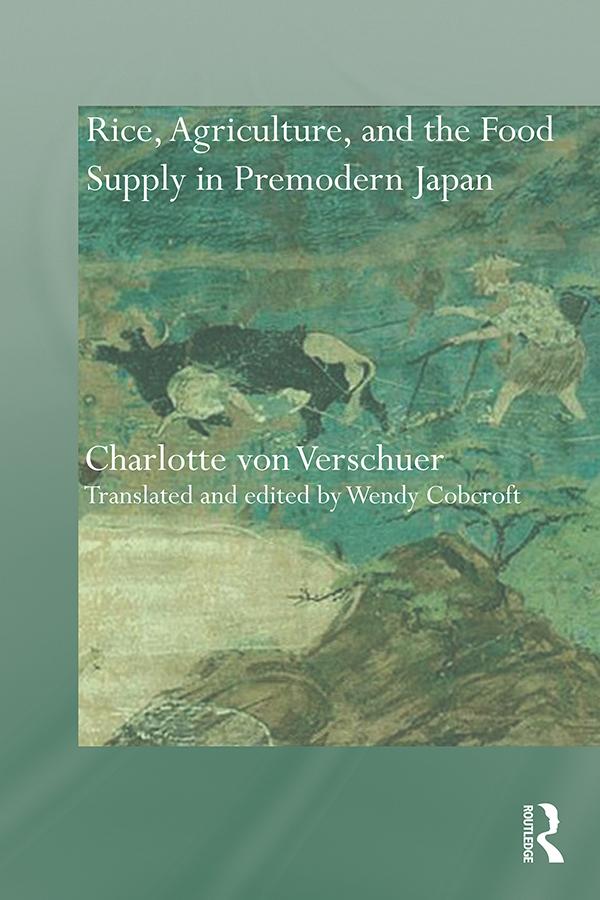
The majority of studies on the agricultural history of Japan have focused on the public administration of land and production, and rice, the principal source of revenue, has received the most attention. However, while this cereal has clearly played a decisive role in the public economy of the Japanese State, it has not had a predominant place in agricultural production. Far from confining its scope to a study of rice growing for tax purposes, this volume looks at the subsistence economy in the plant kingdom as a whole.
This book examines the history of agriculture in premodern Japan from the 8th to the 17th century, dealing with the history of agricultural techniques and food supply of rice, wheat, millet and other grains. Drawing extensively on material from history, literature, archaeology, ethnography and botany, it analyses each of the farming operations from sowing to harvesting, and the customs pertaining to consumption. It also challenges the widespread theory that rice cultivation has been the basis of "Japaneseness" for two millennia and the foundation of Japanese civilization by focusing on the biodiversity and polycultural traditions of Japan. Further, it will play a role in the current dialogue on the future of sustainable agricultural production from the viewpoints of ecology, biodiversity, dietary culture and food security throughout the world as traditional techniques such as crop rotation are explored in connection with the safeguarding of the minerals in the soil.
Surveying agricultural techniques across the centuries and highlighting the dietary diversity of Japan, this book will appeal to students and scholars of Japanese history, the history of science and technology, medieval history, cultural anthropology and agriculture.
Pay easily by card, Klarna, Apple Pay or Google Pay. Not happy? You always have a 14-day money-back guarantee. Read more in our terms. If you have any questions, email us at hello@memmo.org.
Memmo makes studying easier – wherever you are in the world. We bring your course books and smart study tools together in one place: summaries, quizzes, podcasts and flashcards. Plus Ted, your study buddy who answers anything you wonder. Over 50,000 students already study here – built to help you learn faster and stress less.