
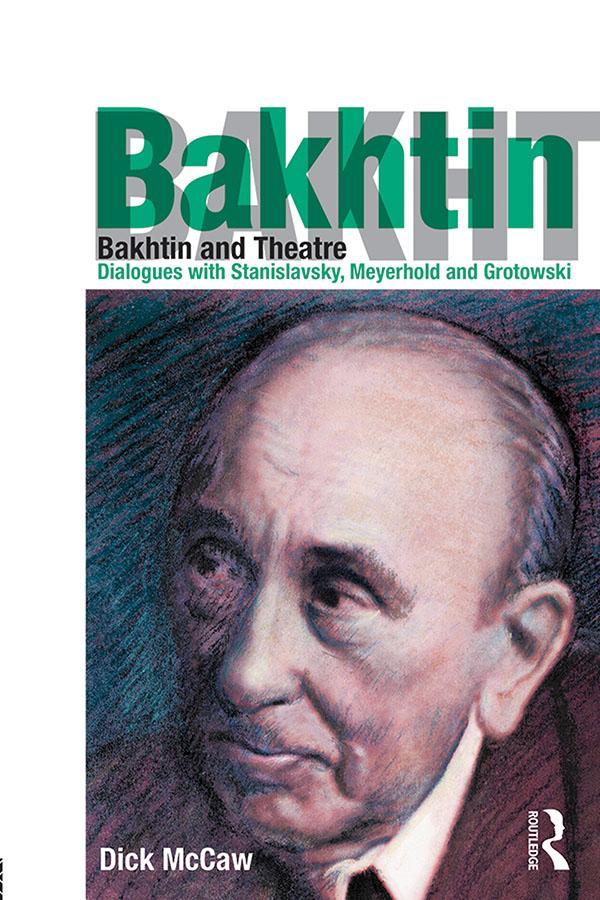
What did Bakhtin think about the theatre? That it was outdated? That is ‘stopped being a serious genre’ after Shakespeare? Could a thinker to whose work ideas of theatricality, visuality, and embodied activity were so central really have nothing to say about theatrical practice?
Bakhtin and Theatre is the first book to explore the relation between Bakhtin’s ideas and the theatre practice of his time. In that time, Stanislavsky co-founded the Moscow Art Theatre in 1898 and continued to develop his ideas about theatre until his death in 1938. Stanislavsky’s pupil Meyerhold embraced the Russian Revolution and created some stunningly revolutionary productions in the 1920s, breaking with the realism of his former teacher. Less than twenty years after Stanislavsky’s death and Meyerhold’s assassination, a young student called Grotowski was studying in Moscow, soon to break the mould with his Poor Theatre. All three directors challenged the prevailing notion of theatre, drawing on, disagreeing with and challenging each other’s ideas. Bakhtin’s early writings about action, character and authorship provide a revealing framework for understanding this dialogue between these three masters of Twentieth Century theatre.
Pay easily by card, Klarna, Apple Pay or Google Pay. Not happy? You always have a 14-day money-back guarantee. Read more in our terms. If you have any questions, email us at hello@memmo.org.
Memmo makes studying easier – wherever you are in the world. We bring your course books and smart study tools together in one place: summaries, quizzes, podcasts and flashcards. Plus Ted, your study buddy who answers anything you wonder. Over 75,000 students already study here – built to help you learn faster and stress less.