
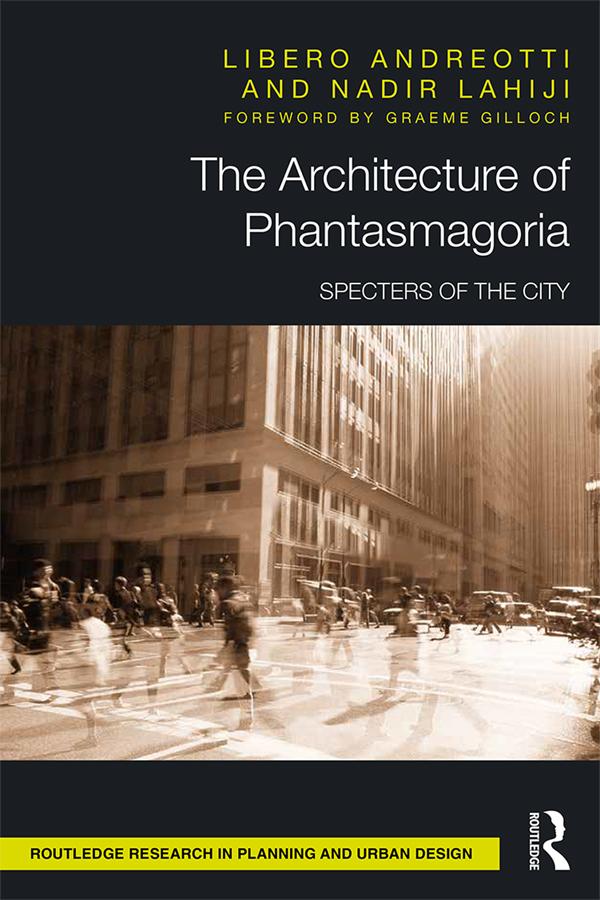
In a time of mass-mediated modernity, the city becomes, almost by definition, a constitutively ‘mediated’ city. Today, more than ever before, the omnipresence of media in every sphere of culture is creating a new urban ontology, saturating, fracturing, and exacerbating the manifold experience of city life. The authors describe this condition as one of 'hyper-mediation' – a qualitatively new phase in the city’s historical evolution. The concept of phantasmagoria has pride of place in their study; using it as an all-embracing explanatory framework, they explore its meanings as a critical category to understand the culture, and the architecture, of the contemporary city.
Andreotti and Lahiji argue that any account of architecture that does not include understanding the role and function of media and its impact on the city in the present ‘tele-technological-capitalist’ society is fundamentally flawed and incomplete. Their approach moves from Walter Benjamin, through the concepts of phantasmagoria and of media – as theorized also by Theodor Adorno, Siegfried Kracauer, and a new generation of contemporary critics – towards a new socio-critical and aesthetic analysis of the mediated space of the contemporary city.
Pay easily by card, Klarna, Apple Pay or Google Pay. Not happy? You always have a 14-day money-back guarantee. Read more in our terms. If you have any questions, email us at hello@memmo.org.
Memmo makes studying easier – wherever you are in the world. We bring your course books and smart study tools together in one place: summaries, quizzes, podcasts and flashcards. Plus Ted, your study buddy who answers anything you wonder. Over 75,000 students already study here – built to help you learn faster and stress less.