
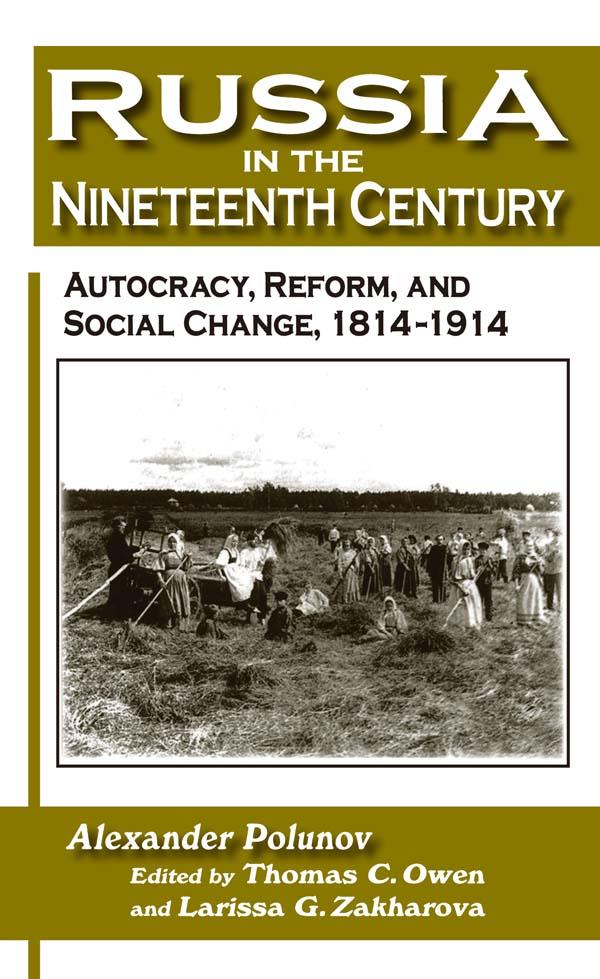
This is a comprehensive interpretive history of Russia from the defeat of Napoleon to the eve of World War I. It is the first such work by a post-Soviet Russian scholar to appear in English. Drawing on the latest Russian and Western historical scholarship, Alexander Polunov examines the decay of the two central institutions of tsarist Russia: serfdom and autocracy. Polunov explains how the major social groups - the gentry, merchants, petty townspeople, peasants, and ethnic minorities - reacted to the Great Reforms, and why, despite the emergence of a civil society and capitalist institutions, a reformist, evolutionary path did not become an alternative to the Revolution of 1917. He provides detailed portraits of many tsarist bureaucrats and political reformers, complete with quotations from their writings, to explain how the principle of autocracy, although significantly weakened by the Great Reforms in mid-century, reasserted itself under the last two emperors. Polunov stresses the relevance, for Russians in the post-Soviet period, of issues that remained unresolved in the pre-Revolutionary period, such as the question of private property in land and the relationship between state regulation and private initiative in the economy.
Pay easily by card, Klarna, Apple Pay or Google Pay. Not happy? You always have a 14-day money-back guarantee. Read more in our terms. If you have any questions, email us at hello@memmo.org.
Memmo makes studying easier – wherever you are in the world. We bring your course books and smart study tools together in one place: summaries, quizzes, podcasts and flashcards. Plus Ted, your study buddy who answers anything you wonder. Over 50,000 students already study here – built to help you learn faster and stress less.
You might also like
Buy the book0