
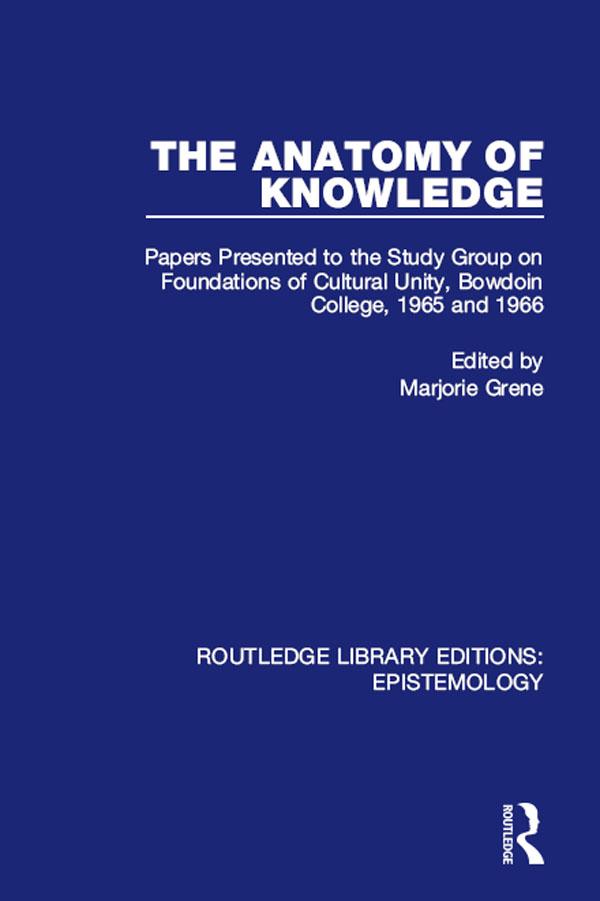
Originally published in 1969. Since the seventeenth century the kind of knowledge afforded by mathematical physics has come more and more to furnish mankind with an ideal for all knowledge. The ideal also carries with it a new conception of the nature of things: all things whatsoever are held to be intelligible ultimately in terms of the laws of inanimate nature. This reductionist formula can be overcome only by the fundamental rethinking of our philosophical premises. To contribute towards thsi rethinking was the aim of the Study Group at whose meetings this collection originated. The essayists come from a wide range of disciplines but all want to address the conflict in our culture.
The first part consists of discussions of various fundamental problems in the sciences. There are essays on the inter-relation of physics and psychology, on the possible reduction of biology to physics and chemistry, on new approaches to experimental psychology, against the possibility of giving a purely ‘factual’ account of social and political life, and for a fundamental reform of our concept of responsibility. The second section of the book suggests lines of philosophical inquiry which might help to resolve the epistemological and ethical problems arising at the foundations of physics, biology, psychology and the social sciences.
Pay easily by card, Klarna, Apple Pay or Google Pay. Not happy? You always have a 14-day money-back guarantee. Read more in our terms. If you have any questions, email us at hello@memmo.org.
Memmo makes studying easier – wherever you are in the world. We bring your course books and smart study tools together in one place: summaries, quizzes, podcasts and flashcards. Plus Ted, your study buddy who answers anything you wonder. Over 50,000 students already study here – built to help you learn faster and stress less.