
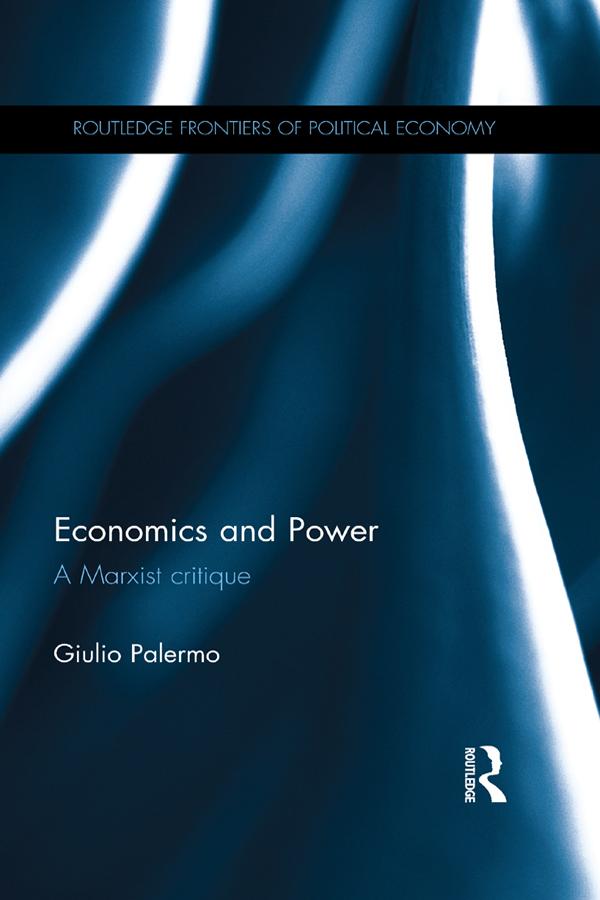
In the economic debate, power is defined and studied mainly as an interpersonal relation occurring out of perfect competition. This is a consequence of the combination of methodological individualism and the assumption of competition as a natural and everlasting coordinating mechanism, operating without any sort of coercion. This methodology, however, is not adequate to analyze the forms of social coercion that characterize capitalism.
Economics and Power criticizes the main theories of power developed in economic literature, analyzing ultraliberal contractualism to radical political economics, and ultimately suggesting a Marxist conception of power and coercion in capitalism. Palermo’s ontological argument is rooted in the philosophy of ‘critical realism’.This unique volume presents his main finding as being that the essential coercive mechanism of capitalism is competition. Capitalist power is not caused by a lack of competition, but by the central role it plays in this mode of production. Following this, the chapters reconstruct a Marxian conception of power where it is analyzed as a social relation and argues that perfect competition does in fact exist under the disguise of capitalist power. This book criticizes the construct of power and the underlying ideas surrounding perfect competition.
This book is of interest to those who study political economy, as well as economic theory and philosophy.
Pay easily by card, Klarna, Apple Pay or Google Pay. Not happy? You always have a 14-day money-back guarantee. Read more in our terms. If you have any questions, email us at hello@memmo.org.
Memmo makes studying easier – wherever you are in the world. We bring your course books and smart study tools together in one place: summaries, quizzes, podcasts and flashcards. Plus Ted, your study buddy who answers anything you wonder. Over 50,000 students already study here – built to help you learn faster and stress less.