
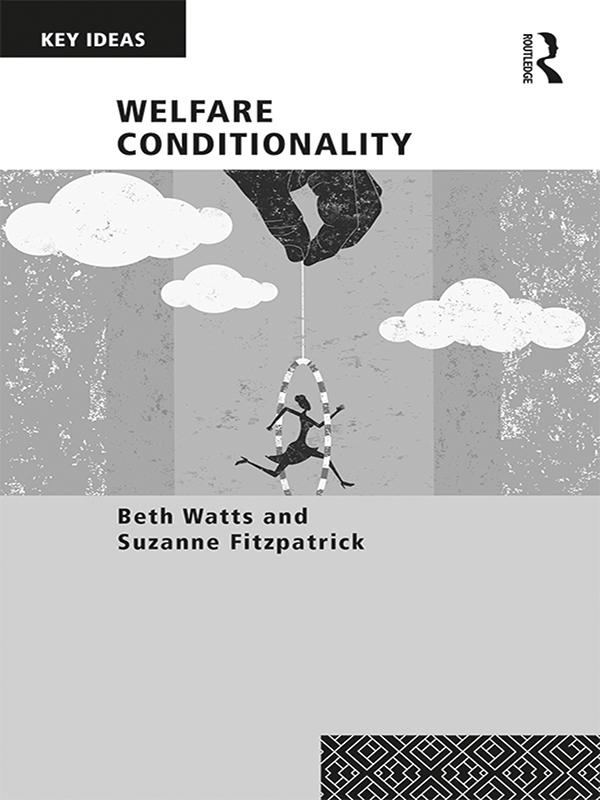
Welfare conditionality has become an idea of global significance in recent years. A ‘hot topic’ in North America, Australia, and across Europe, it has been linked to austerity politics, and the rise of foodbanks and destitution. In the Global South, where publicly funded welfare protection systems are often absent, conditional approaches have become a key tool employed by organisations pursuing human development goals.
The essence of welfare conditionality lies in requirements for people to behave in prescribed ways in order to access cash benefits or other welfare support. These conditions are typically enforced through benefit ‘sanctions’ of various kinds, reflecting a new vision of ‘welfare’, focused more on promoting ‘pro-social’ behaviour than on protecting people against classic ‘social risks’ like unemployment.
This new book in Routledge’s Key Ideas series charts the rise of behavioural conditionality in welfare systems across the globe, its appeal to politicians of Right and Left, and its application to a growing range of social problems. Crucially it explores why, in the context of widespread use of conditional approaches as well as apparently strong public support, both the efficacy and the ethics of welfare conditionality remain so controversial. As such, Welfare Conditionality is essential reading for students, researchers, and commentators in social and public policy, as well as those designing and implementing welfare policies.
Pay easily by card, Klarna, Apple Pay or Google Pay. Not happy? You always have a 14-day money-back guarantee. Read more in our terms. If you have any questions, email us at hello@memmo.org.
Memmo makes studying easier – wherever you are in the world. We bring your course books and smart study tools together in one place: summaries, quizzes, podcasts and flashcards. Plus Ted, your study buddy who answers anything you wonder. Over 50,000 students already study here – built to help you learn faster and stress less.