
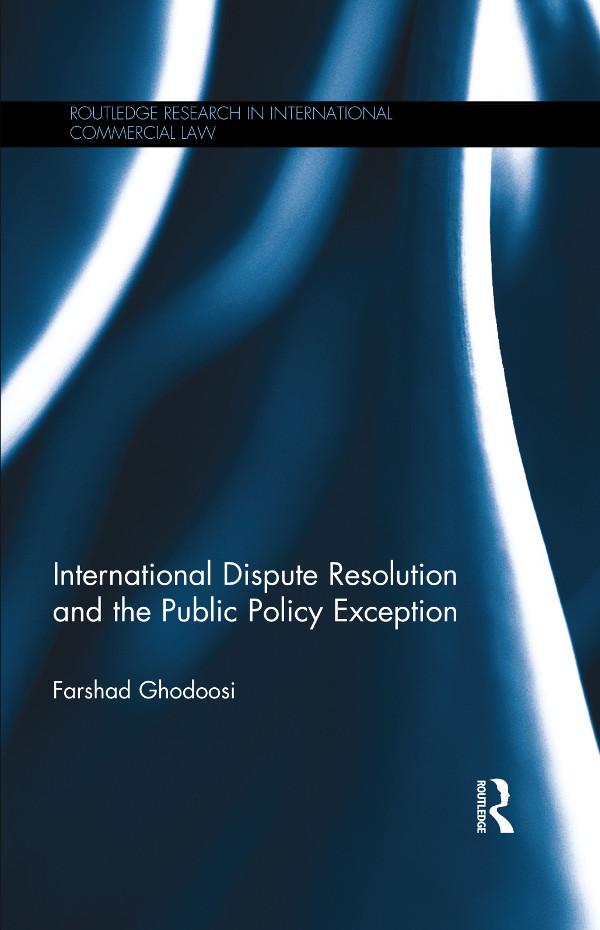
Despite the unprecedented growth of arbitration and other means of ADR in treaties and transnational contracts in recent years, there remains no clearly defined mechanism for control of the system. One of the oldest yet largely marginalized concepts in law is the public policy exception. This doctrine grants discretion to courts to set aside private legal arrangements, including arbitration, which might be considered harmful to the "public". The exceptional and vague nature of the doctrine, along with the strong push of actors in dispute resolution, has transformed it, in certain jurisdictions, to a toothless doctrine. At the international level, the notion of transnational public policy has been devised in order to capture norms that are "truly" transnational and amenable for application in cross-border litigations. Yet, despite the importance of this discussion—a safety valve and a control mechanism for today’s international and domestic international dispute resolution— no major study has ventured to review and analyze it.
This book provides a historical, theoretical and practical background on public policy in dispute resolution with a focus on cross-border and transnational disputes. Farshad Ghodoosi argues that courts should adopt a more systemic approach to public policy while rejecting notions such as transnational public policy, which limits the application of those norms with mandatory nature. Contrary to the current trend, the book invites the reader to re-conceptualize the role of public policy, and transnational dispute resolution, in order to have more sustainable, fair and efficient mechanisms for resolving disputes outside of national courts.
The book sheds light on one of the most important yet often-neglected control mechanisms of today’s international dispute resolution and will be of particular interest to students and academics in the fields of International Investment Law, International Trade Law, Business and Economics.
Pay easily by card, Klarna, Apple Pay or Google Pay. Not happy? You always have a 14-day money-back guarantee. Read more in our terms. If you have any questions, email us at hello@memmo.org.
Memmo makes studying easier – wherever you are in the world. We bring your course books and smart study tools together in one place: summaries, quizzes, podcasts and flashcards. Plus Ted, your study buddy who answers anything you wonder. Over 50,000 students already study here – built to help you learn faster and stress less.