
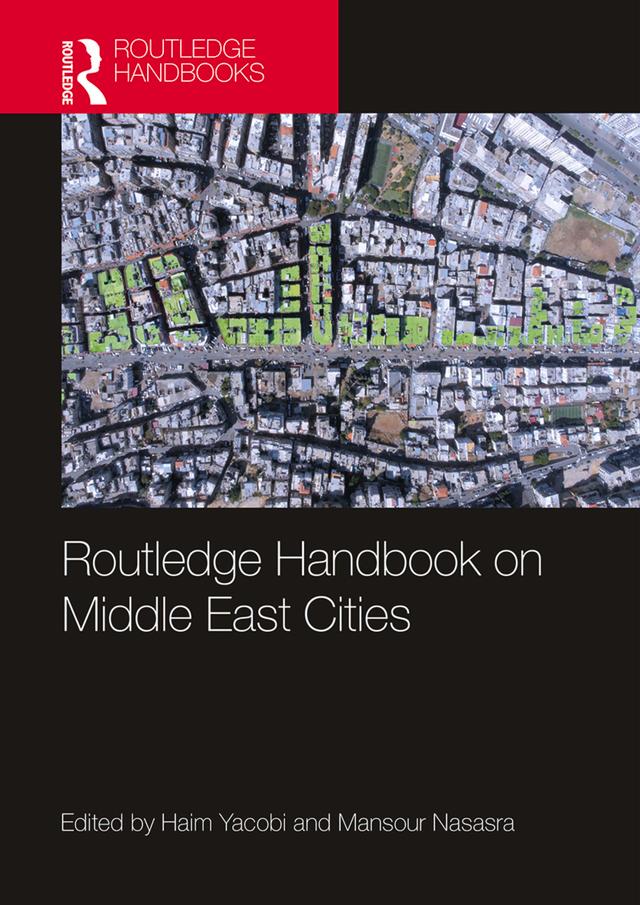
Presenting the current debate about cities in the Middle East from Sana’a, Beirut and Jerusalem to Cairo, Marrakesh and Gaza, the book explores urban planning and policy, migration, gender and identity as well as politics and economics of urban settings in the region.
This handbook moves beyond essentialist and reductive analyses of identity, urban politics, planning, and development in cities in the Middle East, and instead offers critical engagement with both historical and contemporary urban processes in the region. Approaching "Cities" as multi-dimensional sites, products of political processes, knowledge production and exchange, and local and global visions as well as spatial artefacts. Importantly, in the different case studies and theoretical approaches, there is no attempt to idealise urban politics, planning, and everyday life in the Middle East –– which (as with many other cities elsewhere) are also situations of contestation and violence –– but rather to highlight how cities in the region, and especially those which are understudied, revolve around issues of housing, infrastructure, participation and identity, amongst other concerns.
Analysing a variety of cities in the Middle East, the book is a significant contribution to Middle East Studies. It is an essential resource for students and academics interested in Geography, Regional and Urban Studies of the Middle East.
Pay easily by card, Klarna, Apple Pay or Google Pay. Not happy? You always have a 14-day money-back guarantee. Read more in our terms. If you have any questions, email us at hello@memmo.org.
Memmo makes studying easier – wherever you are in the world. We bring your course books and smart study tools together in one place: summaries, quizzes, podcasts and flashcards. Plus Ted, your study buddy who answers anything you wonder. Over 75,000 students already study here – built to help you learn faster and stress less.