
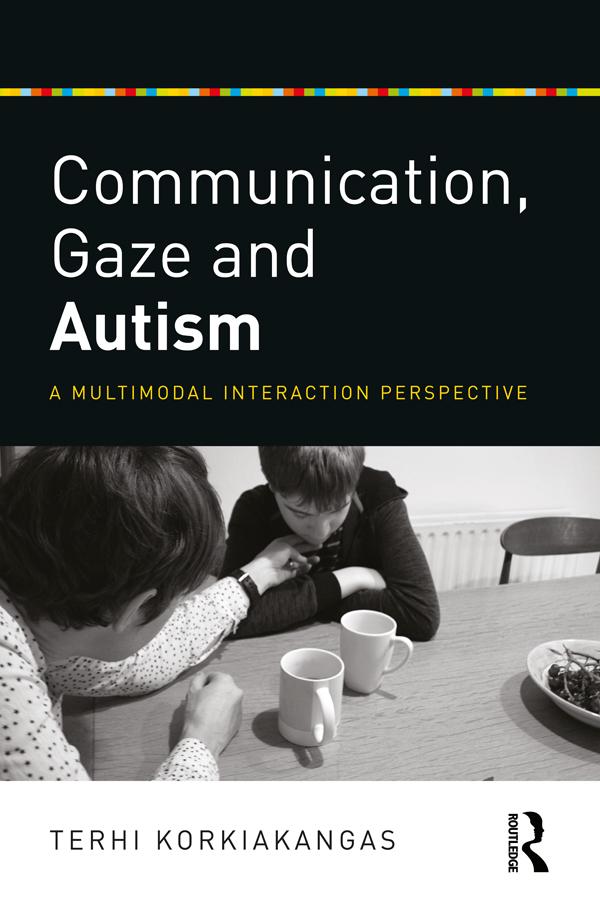
In this innovative book on autism and gaze from a multimodal interaction perspective, Terhi Korkiakangas examines the role of gaze in everyday situations, asking why eye contact matters, and considering the implications of this crucial question for autism. Since persons on the autism spectrum tend to use it differently and might not engage in eye contact in social situations, gaze is a crucial topic for understanding autism, yet we know surprisingly little about this topic in a real-world context, beyond psychological experiments and the research lab.
Drawing on her research on authentic video-recorded social interactions, Korkiakangas shows how a multimodal interaction perspective can shed new light on gaze: what an instance of gaze does, and when, why, and for whom gaze ‘matters’, from both children on the autism spectrum and their social partners’ perspective, including teachers and parents. Grounded in the interactional tradition of conversation analysis, the multimodal interaction perspective offers a major contribution to our understanding of autism by examining communication beyond talk and linguistic resources. Communication, Gaze and Autism considers both mutual gaze and gaze aversion during talk or silence, alongside facial expressions, gestures, and other body movements, to understand what gaze is used for, and to rethink ‘eye contact’. The book includes a methodological introduction, practical tools for doing multimodal interaction research, and empirical findings. It also considers the voices of those people on the autism spectrum from the blogosphere, who suggest that eye contact has less significance for them and represents a communication difference, rather than a deficit.
This book is designed for anyone with an academic, professional or personal interest in autism. It will particularly appeal to senior undergraduate and graduate students, researchers and practitioners in the fields of communication, social interaction and autism.
Pay easily by card, Klarna, Apple Pay or Google Pay. Not happy? You always have a 14-day money-back guarantee. Read more in our terms. If you have any questions, email us at hello@memmo.org.
Memmo makes studying easier – wherever you are in the world. We bring your course books and smart study tools together in one place: summaries, quizzes, podcasts and flashcards. Plus Ted, your study buddy who answers anything you wonder. Over 50,000 students already study here – built to help you learn faster and stress less.