
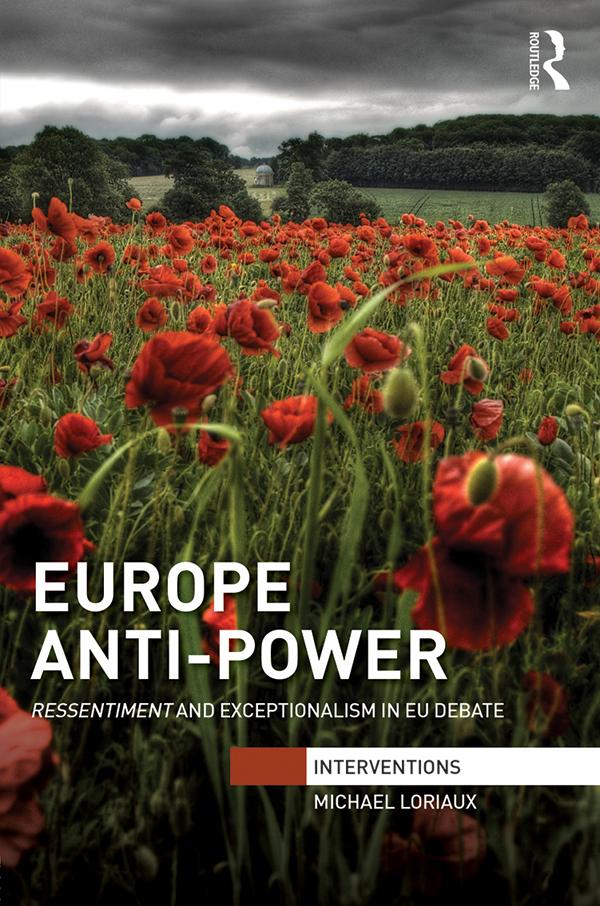
The EU seeks to define a role for itself in power politics while remaining firm in its rejection of power politics. In order to make power compatible with the European project, EU debate has appended a number of progressive adjectives to the word "power," adjectives like "civilian" and "normative," among others. This book asks what is power, such that it can be modified, tamed, and modulated by adjectives, yet remain "powerful"?
Loriaux passes EU debate on power through the mill of phenomenological and post-phenomenological analysis, juxtaposing it against writings by Machiavelli, Agamben, Thucydides, Nietzsche, Patocka, and Levinas. The book locates power in "power/play," the theatrical, staged representation of threat that generates aesthetic effect and undecidability. Power/play endows the word "power" with perlocutionary force, which the adjectives of EU "qualified" power actually enhance rather than moderate. Loriaux argues that EU discourse on power therefore risks inviting EU "exceptionalism," or risks lapsing into an expression of EU ressentiment, rather than advancing a new, progressive understanding of "power." If European Union is to remain steadfast in its opposition to power politics, it must represent itself as "anti-power."
This book will be of interest to those who work in the area of EU foreign policy, as well as to those who have a more general theoretical interest in the concept of power.
Pay easily by card, Klarna, Apple Pay or Google Pay. Not happy? You always have a 14-day money-back guarantee. Read more in our terms. If you have any questions, email us at hello@memmo.org.
Memmo makes studying easier – wherever you are in the world. We bring your course books and smart study tools together in one place: summaries, quizzes, podcasts and flashcards. Plus Ted, your study buddy who answers anything you wonder. Over 50,000 students already study here – built to help you learn faster and stress less.