
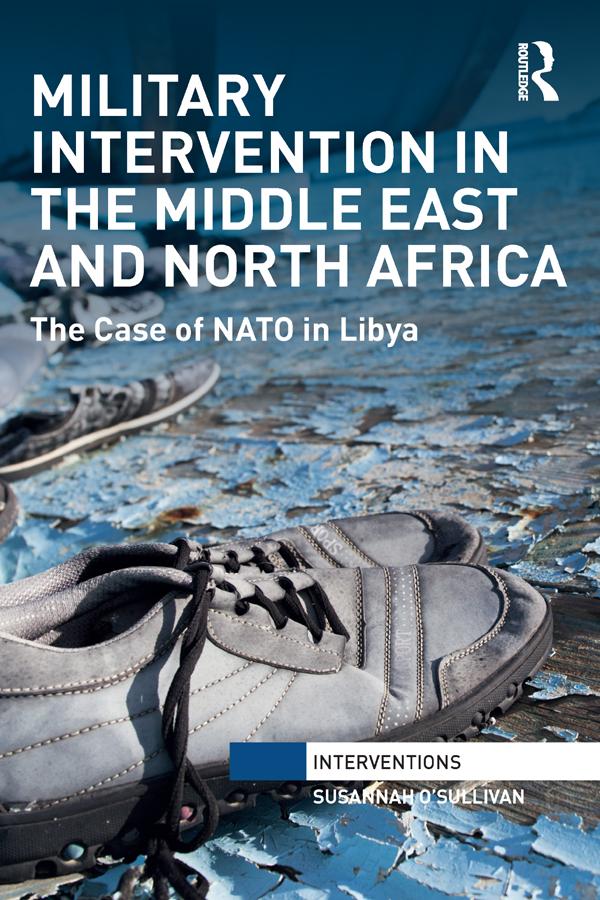
This book contributes to an increasingly important branch of critical security studies that combines insights from critical geopolitics and postcolonial critique by making an argument about the geographies of violence and their differential impact in contemporary security practices, including but not limited to military intervention. The book explores military intervention in Libya through the categories of space and time, to provide a robust ethico-political critique of the intervention.
Much of the mainstream international relations scholarship on humanitarian intervention frames the ethical, moral and legal debate over intervention in terms of a binary, between human rights and state sovereignty. In response, O’Sullivan questions the ways in which military violence was produced as a rational and reasonable response to the crisis in Libya, outlining and destabilising this false binary between the human and the state. The book offers methodological tools for questioning the violent institutions at the heart of humanitarian intervention and asking how intervention has been produced as a rational response to crisis.
Contributing to the ongoing academic conversation in the critical literature on spatiality, militarism and resistance, the book draws upon postcolonial and poststructural approaches to critical security studies, and will be of great interest to scholars and graduates of critical security studies and international relations.
Pay easily by card, Klarna, Apple Pay or Google Pay. Not happy? You always have a 14-day money-back guarantee. Read more in our terms. If you have any questions, email us at hello@memmo.org.
Memmo makes studying easier – wherever you are in the world. We bring your course books and smart study tools together in one place: summaries, quizzes, podcasts and flashcards. Plus Ted, your study buddy who answers anything you wonder. Over 50,000 students already study here – built to help you learn faster and stress less.