
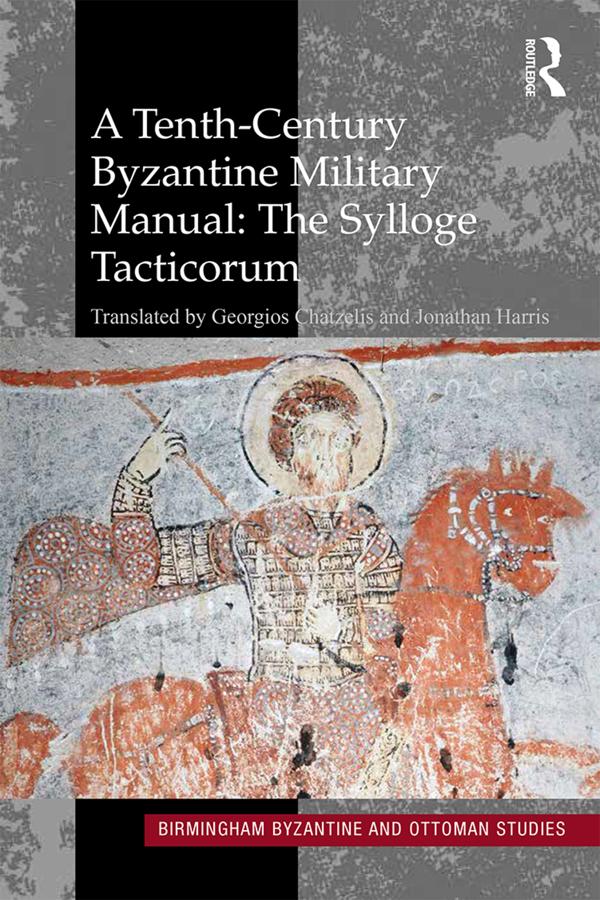
The Sylloge Tacticorum is a mid-Byzantine example of the literary genre of military manuals or Taktika which stretches back to antiquity. It was one of a number produced during the tenth century CE, a period when the Byzantine empire enjoyed a large measure of success in its wars against its traditional enemy, the Arabs. Compiled to record and preserve military strategies, know-how, and tactics, the manual discusses a wide variety of matters: battle formations, raids, sieges, ambushes, surprise attacks, the treatment of prisoners of war and defectors, distribution of booty, punishment of military offences, how to mount effective espionage, and how to send and receive envoys. There is even advice on the personal qualities required by generals, on how to neutralize enemy horses, and on how to protect the troops against poisoned food. The work culminates in an account of the stratagems employed by great Greek and Roman military commanders of the past. While, like so much of Byzantine literature, the Sylloge often simply reproduces material found in earlier texts, it also preserves a great deal of information about the military tactics being developed by the Byzantine army during the tenth century. It is the first Byzantine source to record the reappearance of a specialized heavy cavalry (the kataphraktoi) and of a specialized infantry (the menavlatoi) used to repel the attacks of the opposing heavy cavalry. There is also a great deal of information on new infantry and cavalry formations and on the new tactics that required them.
This is the first complete translation of the Sylloge into English. It is accompanied by a glossary of the specialised Greek military vocabulary used in the work and by footnotes which explain obscure references and identify the author’s classical and Byzantine sources. An introduction places the work in its historical and literary context and considers some of the questions that have remained unanswered over the centuries, such as its authorship and the date of its composition.
Pay easily by card, Klarna, Apple Pay or Google Pay. Not happy? You always have a 14-day money-back guarantee. Read more in our terms. If you have any questions, email us at hello@memmo.org.
Memmo makes studying easier – wherever you are in the world. We bring your course books and smart study tools together in one place: summaries, quizzes, podcasts and flashcards. Plus Ted, your study buddy who answers anything you wonder. Over 50,000 students already study here – built to help you learn faster and stress less.