
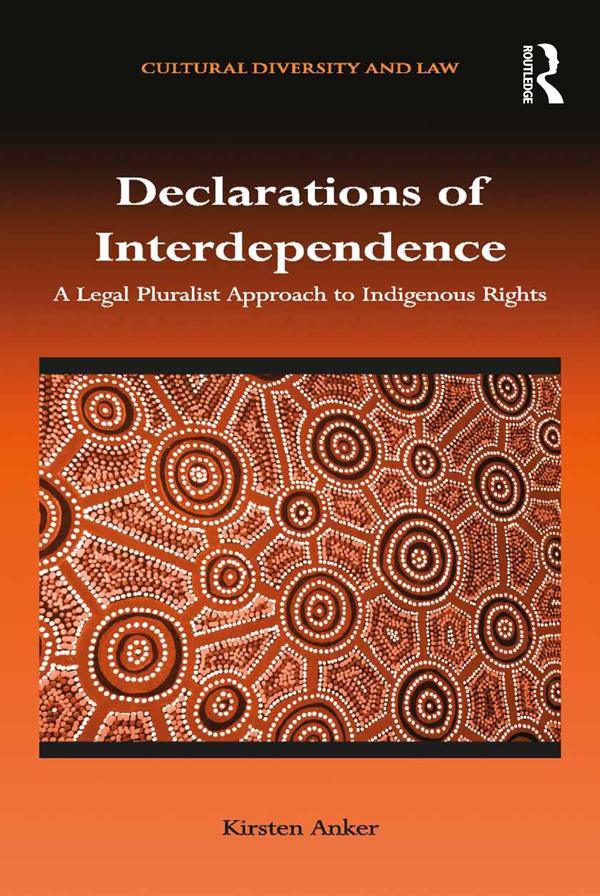
This book takes up the postcolonial challenge for law and explains how the problems of legal recognition for Indigenous peoples are tied to an orthodox theory of law. Constructing a theory of legal pluralism that is both critical of law's epistemological and ontological presuppositions, as well as discursive in engaging a dialogue between legal traditions, Anker focusses on prominent aspects of legal discourse and process such as sovereignty, proof, cultural translation and negotiation. With case studies and examples principally drawn from Australia and Canada, the book seeks to set state law in front of its own reflection in the mirror of Indigenous rights, drawing on a broad base of scholarship in addition to legal theory, from philosophy, literary studies, anthropology, social theory, Indigenous studies and art. As a contribution to legal theory, the study advances legal pluralist approaches not just by imagining a way to ’make space for’ Indigenous legal traditions, but by actually working with their insights in building theory. The book will be of value to students and researchers interested in Indigenous rights as well as those working in the areas of socio-legal studies, legal pluralism and law and cultural diversity.
Pay easily by card, Klarna, Apple Pay or Google Pay. Not happy? You always have a 14-day money-back guarantee. Read more in our terms. If you have any questions, email us at hello@memmo.org.
Memmo makes studying easier – wherever you are in the world. We bring your course books and smart study tools together in one place: summaries, quizzes, podcasts and flashcards. Plus Ted, your study buddy who answers anything you wonder. Over 50,000 students already study here – built to help you learn faster and stress less.
You might also like
Buy the book0