
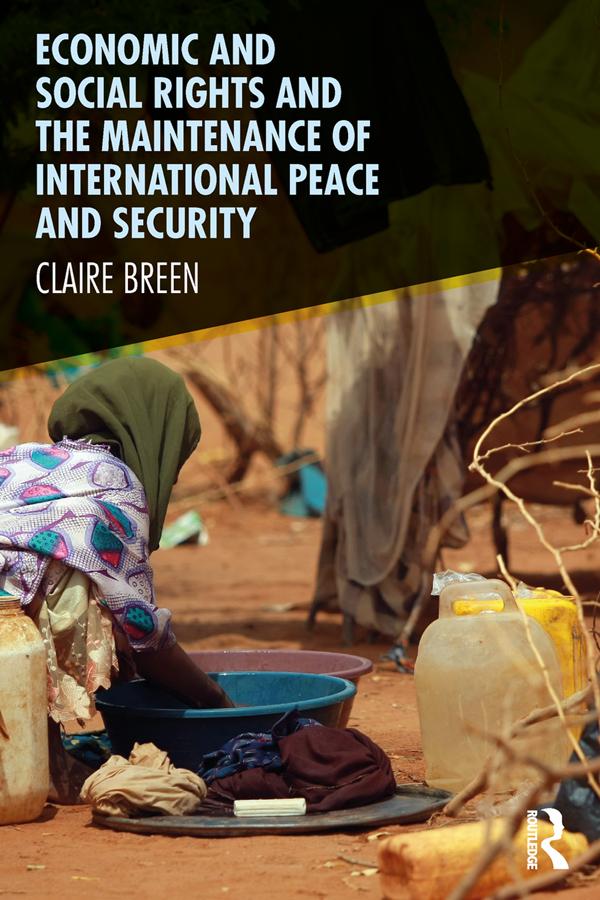
This text comprises cutting-edge research on one of the greatest global challenges: the failure to address systematic economic and social exclusion, and attendant violations of economic and social rights (ESR), as a driver of conflict. The text explores what the UN's obligation to maintain international peace and security can mean when it is informed by the requirement to protect and promote ESR, rights that play a crucial role in maintaining international peace and security but which are often overlooked. The book considers the extent to which Security Council mandated peace operations have been informed by human rights and efforts to promote economic and social development. The approach is to analyse the extent to which the Security Council has interacted with the General Assembly, the Economic and Social Council as well as other Charter-based mechanisms such as the Human Rights Council, and its predecessor, with particular reference to the role of the Special Procedure Mechanisms. The role of the UN High Commissioner for Human Rights is also considered. In this way, the text shows that the connection between peace and security and human rights is well recognised by these organs. In addition, the text considers States’ ESR obligations stemming from the extraterritorial application of such rights in the context of peace operations. Given that States’ obligations stemming from ESR have often been neglected, the book examines how such provision could be improved using ESR-grounded plans reflecting the rights to health, food, water, education, work and life. The text concludes with a call to reimagine what international peace and security can look like when it is informed by the need to recognise the emergence of post-conflict legal obligations based on broader concepts of international peace and security that draw from ESR. This text will appeal to legal scholars, policy advisors, members of the military, those working in the area of development, NGOs and final-year undergraduate and/or postgraduate students working in the areas of international law, political science and international relations, and associated fields of research.
Pay easily by card, Klarna, Apple Pay or Google Pay. Not happy? You always have a 14-day money-back guarantee. Read more in our terms. If you have any questions, email us at hello@memmo.org.
Memmo makes studying easier – wherever you are in the world. We bring your course books and smart study tools together in one place: summaries, quizzes, podcasts and flashcards. Plus Ted, your study buddy who answers anything you wonder. Over 50,000 students already study here – built to help you learn faster and stress less.