
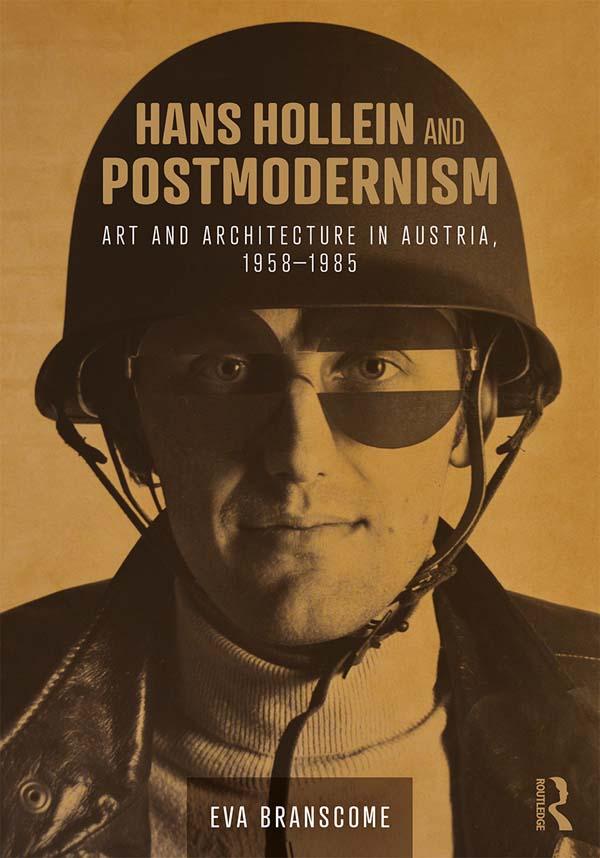
Set within the broader context of post-war Austria and the re-education initiatives set up by the Allied forces, particularly the US, this book investigates the art and architecture scene in Vienna to ask how this can inform our broader understanding of architectural Postmodernism.
The book focuses on the outputs of the Austrian artist and architect, Hans Hollein, and on his appropriation as a Postmodernist figure. In Vienna, the circles of radical art and architecture were not distinct, and Hollein’s claim that ‘Everything is Architecture’ was symptomatic of this intermixing of creative practices. Austria's proximity to the so-called ‘Iron Curtain’ and its post-war history of four-power occupation gave a heightened sense of menace that emerged strongly in Viennese art in the Cold War era. Seen as a collective entity, Hans Hollein’s works across architecture, art, writing, exhibition design and publishing clearly require a more diverse, complex and culturally nuanced account of architectural Postmodernism than that offered by critics at the time.
Across the five chapters, Hollein's outputs are viewed not as individual projects, but as symptomatic of Austria's attempts to come to terms with its Nazi past and to establish a post-war identity.
Pay easily by card, Klarna, Apple Pay or Google Pay. Not happy? You always have a 14-day money-back guarantee. Read more in our terms. If you have any questions, email us at hello@memmo.org.
Memmo makes studying easier – wherever you are in the world. We bring your course books and smart study tools together in one place: summaries, quizzes, podcasts and flashcards. Plus Ted, your study buddy who answers anything you wonder. Over 75,000 students already study here – built to help you learn faster and stress less.