
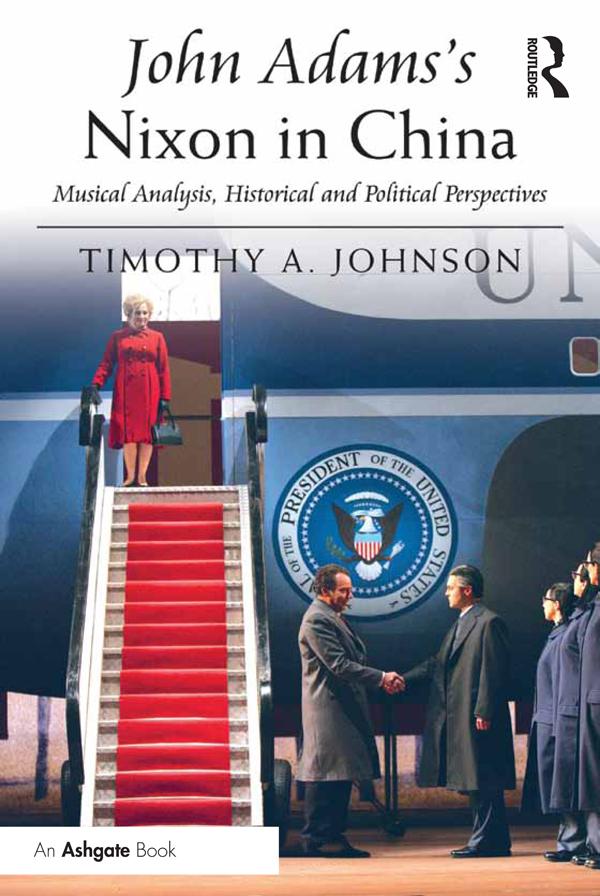
John Adams's opera, Nixon in China, is one of the most frequently performed operas in the contemporary literature. Timothy A. Johnson illuminates the opera and enhances listeners' and scholars' appreciation for this landmark work. This music-analytical guide presents a detailed, in-depth analysis of the music tied to historical and political contexts. The opera captures an important moment in history and in international relations, and a close study of it from an interdisciplinary perspective provides fresh, compelling insights about the opera. The music analysis takes a neo-Riemannian approach to harmony and to large-scale harmonic connections. Musical metaphors drawn between harmonies and their dramatic contexts enrich this approach. Motivic analysis reveals interweaving associations between the characters, based on melodic content. Analysis of rhythm and meter focuses on Adams's frequent use of grouping and displacement dissonances to propel the music forward or to illustrate the libretto. The book shows how the historical depiction in the opera is accurate, yet enriched by this operatic adaptation. The language of the opera is true to its source, but more evocative than the words spoken in 1972-due to Alice Goodman's marvelous, poetic libretto. And the music transcends its repetitive shell to become a hierarchically-rich and musically-compelling achievement.
Pay easily by card, Klarna, Apple Pay or Google Pay. Not happy? You always have a 14-day money-back guarantee. Read more in our terms. If you have any questions, email us at hello@memmo.org.
Memmo makes studying easier – wherever you are in the world. We bring your course books and smart study tools together in one place: summaries, quizzes, podcasts and flashcards. Plus Ted, your study buddy who answers anything you wonder. Over 50,000 students already study here – built to help you learn faster and stress less.
You might also like
Buy the book0