
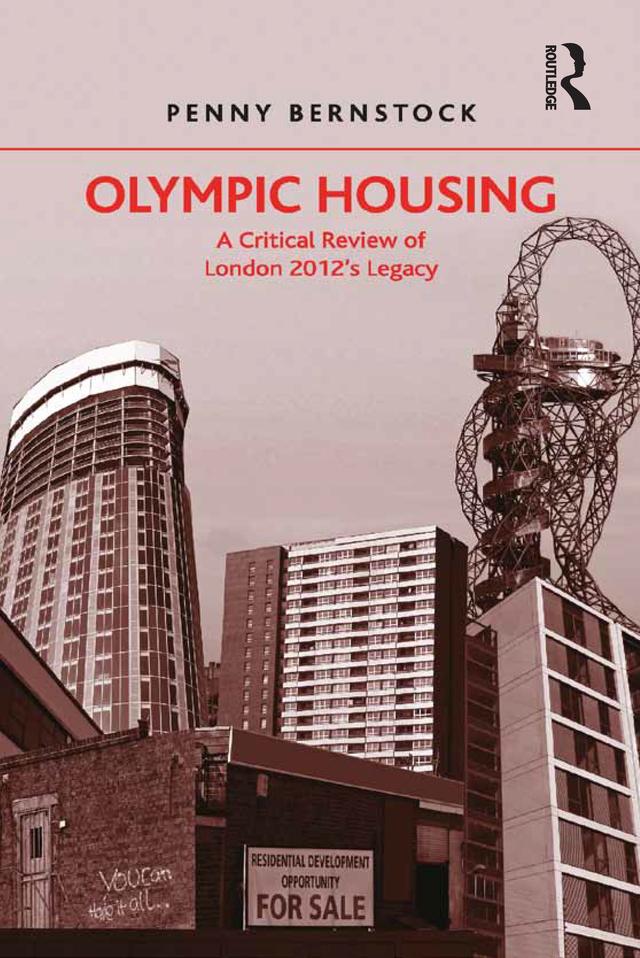
One of the distinguishing characteristics of London's bid to host the games was its commitment to legacy where it was argued that ’the legacy would lead to the regeneration of an entire community for the direct benefit of everyone who lives there’. This book adopts a critical approach to the concept of 'legacy' focussing specifically on housing. It argues there will be a range of both intended and unintended legacy outcomes and an urgent need for revised strategies if those original objectives are to be achieved. The concept of legacy is explored in a number of ways, including an overview of housing legacy in other host cities; the experiences and perspectives of those residents decanted to make way for the Olympic Park; a critical review of legacy plans; a detailed analysis of the conversion of the Athletes’ Village into housing; and a case study of the emerging area ’Stratford High Street’, which explores issues of social class change and the limitation of planning policies. Whilst taking housing as its focus, this book adopts a sociological perspective by exploring the likelihood of social class change in order to draw conclusions about 'gentrification', 'social polarisation' and the extent to which 'social inclusion' is reflected in housing legacies.
Pay easily by card, Klarna, Apple Pay or Google Pay. Not happy? You always have a 14-day money-back guarantee. Read more in our terms. If you have any questions, email us at hello@memmo.org.
Memmo makes studying easier – wherever you are in the world. We bring your course books and smart study tools together in one place: summaries, quizzes, podcasts and flashcards. Plus Ted, your study buddy who answers anything you wonder. Over 75,000 students already study here – built to help you learn faster and stress less.
You might also like
Buy the book0