
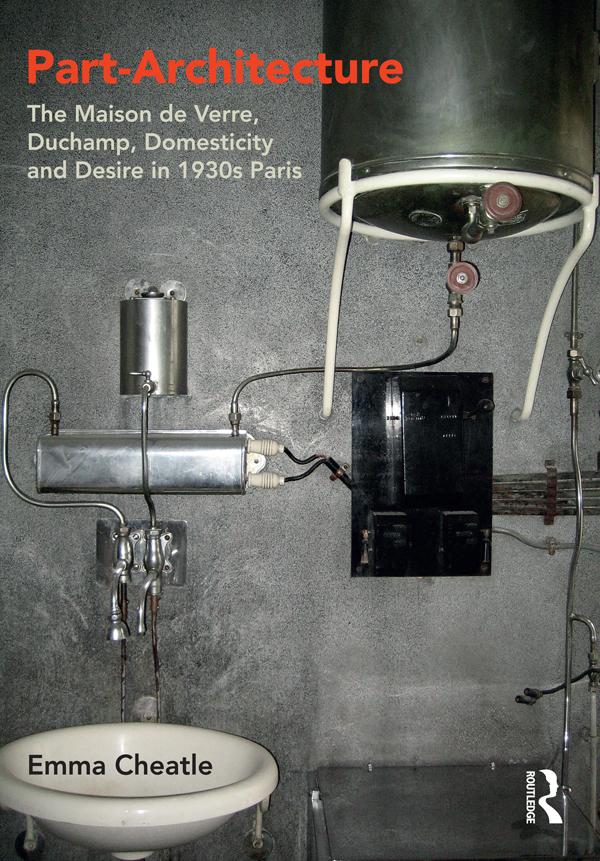
Part-Architecture presents a detailed and original study of Pierre Chareau’s Maison de Verre through another seminal modernist artwork, Marcel Duchamp’s Large Glass. Aligning the two works materially, historically and conceptually, the book challenges the accepted architectural descriptions of the Maison de Verre, makes original spatial and social accounts of its inhabitation in 1930s Paris, and presents new architectural readings of the Large Glass. Through a rich analysis, which incorporates creative projects into history and theory research, the book establishes new ways of writing about architecture.
Designed for politically progressive gynaecologist Dr Jean Dalsace and his avant-garde wife, Annie Dalsace, the Maison de Verre combines a family home with a gynaecology clinic into a ‘free-plan’ layout. Screened only by glass walls, the presence of the clinic in the home suggests an untold dialogue on 1930s sexuality. The text explores the Maison de Verre through another radical glass construction, the Large Glass, where Duchamp’s complex depiction of unconsummated sexual relations across the glass planes reveals his resistance to the marital conventions of 1920s Paris. This and other analyses of the Large Glass are used as a framework to examine the Maison de Verre as a register of the changing history of women’s domestic and maternal choices, reclaiming the building as a piece of female social architectural history.
The process used to uncover and write the accounts in the book is termed ‘part-architecture’. Derived from psychoanalytic theory, part-architecture fuses analytical, descriptive and creative processes, to produce a unique social and architectural critique. Identifying three essential materials to the Large Glass, the book has three main chapters: ‘Glass’, ‘Dust’ and ‘Air’. Combining theory text, creative writing and drawing, each traces the history and meaning of the material and its contribution to the spaces and sexuality of the Large Glass and the Maison de Verre. As a whole, the book contributes important and unique spatial readings to existing scholarship and expands definitions of architectural design and history.
Pay easily by card, Klarna, Apple Pay or Google Pay. Not happy? You always have a 14-day money-back guarantee. Read more in our terms. If you have any questions, email us at hello@memmo.org.
Memmo makes studying easier – wherever you are in the world. We bring your course books and smart study tools together in one place: summaries, quizzes, podcasts and flashcards. Plus Ted, your study buddy who answers anything you wonder. Over 75,000 students already study here – built to help you learn faster and stress less.