
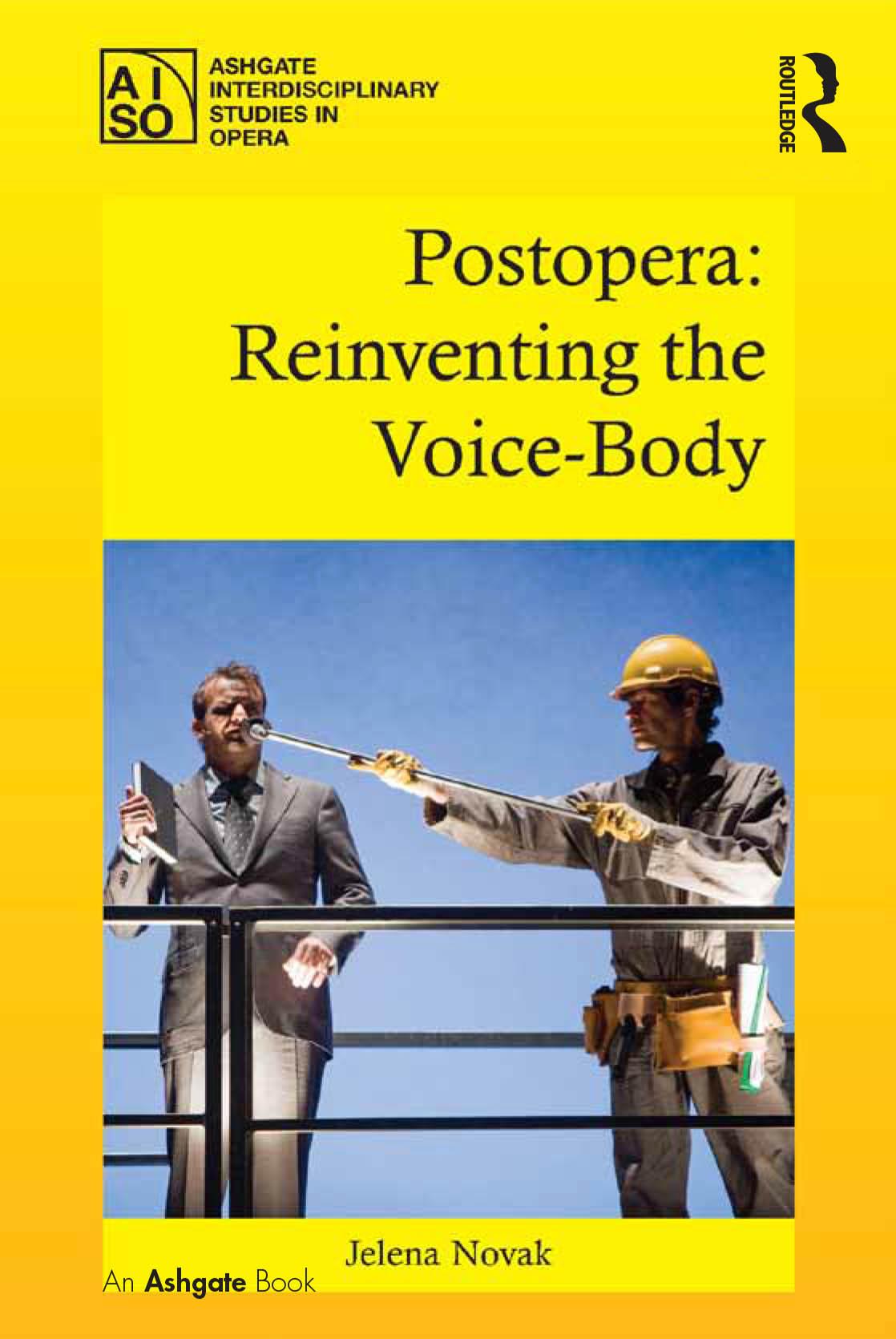
Both in opera studies and in most operatic works, the singing body is often taken for granted. In Postopera: Reinventing the Voice-Body, Jelena Novak reintroduces an awareness of the physicality of the singing body to opera studies. Arguing that the voice-body relationship itself is a producer of meaning, she furthermore posits this relationship as one of the major driving forces in recent opera. She takes as her focus six contemporary operas - La Belle et la Bête (Philip Glass), Writing to Vermeer (Louis Andriessen, Peter Greenaway), Three Tales (Steve Reich, Beryl Korot), One (Michel van der Aa), Homeland (Laurie Anderson), and La Commedia (Louis Andriessen, Hal Hartley) - which she terms 'postoperas'. These pieces are sites for creative exploration, where the boundaries of the opera world are stretched. Central to this is the impact of new media, a de-synchronization between image and sound, or a redefinition of body-voice-gender relationships. Novak dissects the singing body as a set of rules, protocols, effects, and strategies. That dissection shows how the singing body acts within the world of opera, what interventions it makes, and how it constitutes opera’s meanings.
Pay easily by card, Klarna, Apple Pay or Google Pay. Not happy? You always have a 14-day money-back guarantee. Read more in our terms. If you have any questions, email us at hello@memmo.org.
Memmo makes studying easier – wherever you are in the world. We bring your course books and smart study tools together in one place: summaries, quizzes, podcasts and flashcards. Plus Ted, your study buddy who answers anything you wonder. Over 50,000 students already study here – built to help you learn faster and stress less.