
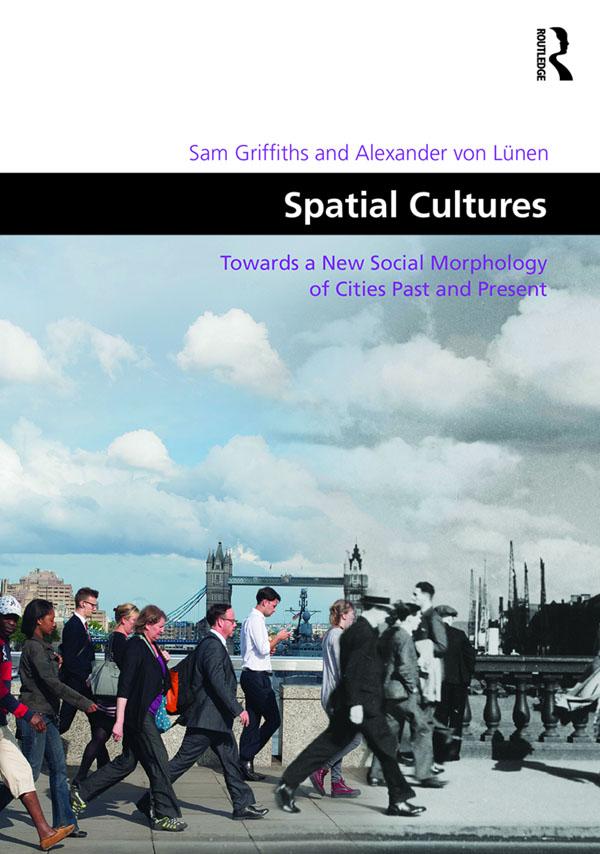
What is the relationship between how cities work and what cities mean? Spatial Cultures: Towards a New Social Morphology of Cities Past and Present announces an innovative research agenda for urban studies in which themes and methods from urban history, social theory and built environment research are brought into dialogue across disciplinary and chronological boundaries. The collection confronts the recurrent epistemological impasse that arises between research focussing on the description of material built environments and that which is concerned primarily with the people who inhabit, govern and write about cities past and present. A reluctance to engage substantively with this issue has been detrimental to scholarly efforts to understand the urban built environment as a meaningful agent of human social experience. Drawing on a wide range of historical and contemporary urban case studies, as well as a selection of theoretical and methodological reflections, the contributions to this volume seek to historically, geographically and architecturally contextualize diverse spatial practices including movement, encounter, play, procession and neighbourhood. The aim is to challenge their tacit treatment as universal categories in much writing on cities and to propose alternative research possibilities with implications as much for urban design thinking as for history and the social sciences.
Pay easily by card, Klarna, Apple Pay or Google Pay. Not happy? You always have a 14-day money-back guarantee. Read more in our terms. If you have any questions, email us at hello@memmo.org.
Memmo makes studying easier – wherever you are in the world. We bring your course books and smart study tools together in one place: summaries, quizzes, podcasts and flashcards. Plus Ted, your study buddy who answers anything you wonder. Over 75,000 students already study here – built to help you learn faster and stress less.