
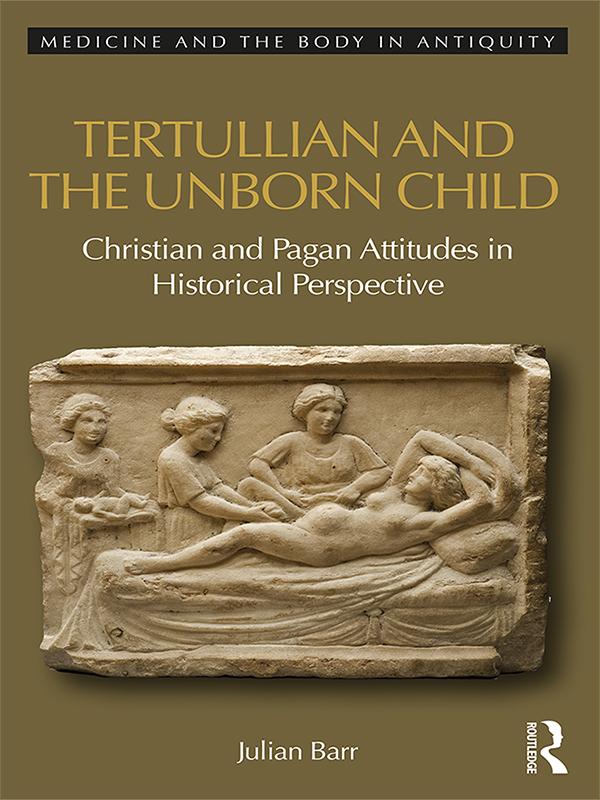
Tertullian of Carthage was the earliest Christian writer to argue against abortion at length, and the first surviving Latin author to consider the unborn child in detail. This book is the first comprehensive analysis of Tertullian’s attitude towards the foetus and embryo. Examining Tertullian’s works in light of Roman literary and social history, Julian Barr proposes that Tertullian's comments on the unborn should be read as rhetoric ancillary to his primary arguments. Tertullian’s engagement in the art of rhetoric also explains his tendency towards self-contradiction. He argued that human existence began at conception in some treatises and not in others. Tertullian’s references to the unborn hence should not be plucked out of context, lest they be misread. Tertullian borrowed, modified, and discarded theories of ensoulment according to their usefulness for individual treatises. So long as a single work was internally consistent, Tertullian was satisfied. He elaborated upon previous Christian traditions and selectively borrowed from ancient embryological theory to prove specific theological and moral points. Tertullian was more influenced by Roman custom than he would perhaps have admitted, since the contrast between pagan and Christian attitudes on abortion was more rhetorical than real.
Pay easily by card, Klarna, Apple Pay or Google Pay. Not happy? You always have a 14-day money-back guarantee. Read more in our terms. If you have any questions, email us at hello@memmo.org.
Memmo makes studying easier – wherever you are in the world. We bring your course books and smart study tools together in one place: summaries, quizzes, podcasts and flashcards. Plus Ted, your study buddy who answers anything you wonder. Over 50,000 students already study here – built to help you learn faster and stress less.