
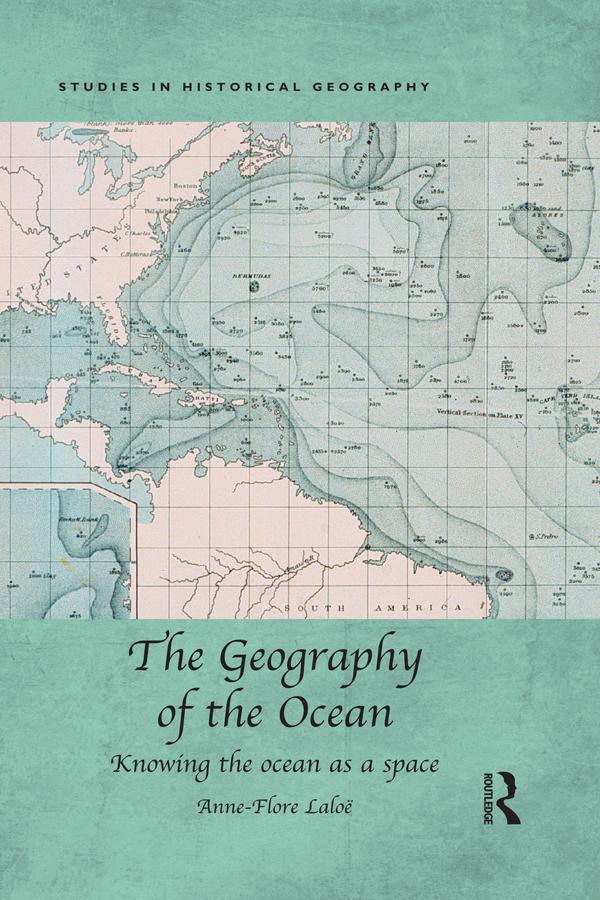
Despite the fact that the vast majority of the earth’s surface is made up of oceans, there has been surprisingly little work by geographers which critically examines the ocean-space and our knowledge and perceptions of it. This book employs a broad conceptual and methodological framework to analyse specific events that have contributed to the production of geographical knowledge about the ocean. These include, but are not limited to, Christopher Columbus’ first transatlantic journey, the mapping of nonexistent islands, the establishment of transoceanic trade routes, the discovery of largescale water movements, the HMS Challenger expedition, the search for the elusive Terra Australis Incognita, the formulation of the theory of continental drift and the mapping of the seabed.
Using a combination of original, empirical (archival, material and cartographic), and theoretical sources, this book uniquely brings together fascinating narratives throughout history to produce a representation and mapping of geographical oceanic knowledge. It questions how we know what we know about the oceans and how this knowledge is represented and mapped. The book then uses this representation and mapping as a way to coherently trace the evolution of oceanic spatial awareness.
In recent years, particularly in historical geography, discovering and knowing the ocean-space has been a completely separate enterprise from discovering and colonising the lands beyond it. There has been such focus on studying colonised lands, yet the oceans between them have been neglected. This book gives the geographical ocean a voice to be acknowledged as a space where history, geography and indeed historical geography took place.
Pay easily by card, Klarna, Apple Pay or Google Pay. Not happy? You always have a 14-day money-back guarantee. Read more in our terms. If you have any questions, email us at hello@memmo.org.
Memmo makes studying easier – wherever you are in the world. We bring your course books and smart study tools together in one place: summaries, quizzes, podcasts and flashcards. Plus Ted, your study buddy who answers anything you wonder. Over 50,000 students already study here – built to help you learn faster and stress less.