
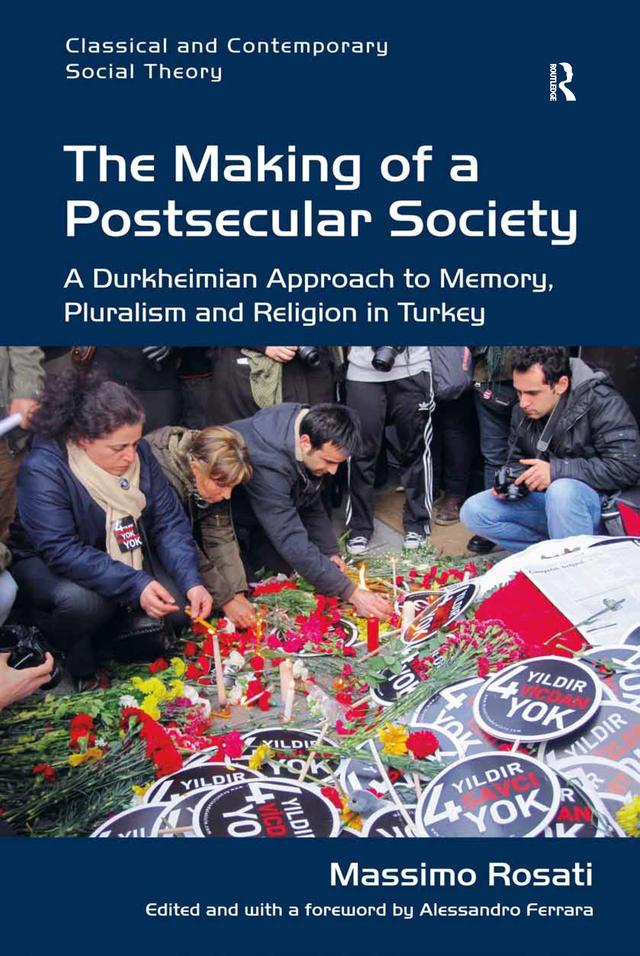
Drawing on the thought of Durkheim, this volume focuses on societal changes at the symbolic level to develop a new conceptualisation of the emergence of postsecular societies. Neo-Durkheimian categories are applied to the case of Turkey, which in recent years has shifted from a strong Republican and Kemalist view of secularism to a more Anglo-Saxon perspective. Turkish society thus constitutes an interesting case that blurs modernist distinctions between the secular and the religious and which could be described as ’postsecular’. Presenting three symbolic case studies - the enduring image of the founder of the Republic Atatürk, the contested site of Ayasofia, and the remembering and commemoration of the murdered journalist Hrant Dink - The Making of a Postsecular Society analyses the cultural relationship that the modern Republic has always had with Europe, considering the possible implications of the Turkish model of secularism for a specifically European self-understanding of modernity. Based on a rigorous construction of theoretical categories and on a close scrutiny of the common challenges confronting Europe and its Turkish neighbour long considered ’other’ with regard to the accommodation of religious difference, this book sheds light on the possibilities for Europe to find new ways of arranging the relationship between the secular and the religious. As such, it will appeal to scholars of social theory, the sociology of religion, secularisation and religious difference, and social change.
Pay easily by card, Klarna, Apple Pay or Google Pay. Not happy? You always have a 14-day money-back guarantee. Read more in our terms. If you have any questions, email us at hello@memmo.org.
Memmo makes studying easier – wherever you are in the world. We bring your course books and smart study tools together in one place: summaries, quizzes, podcasts and flashcards. Plus Ted, your study buddy who answers anything you wonder. Over 50,000 students already study here – built to help you learn faster and stress less.