
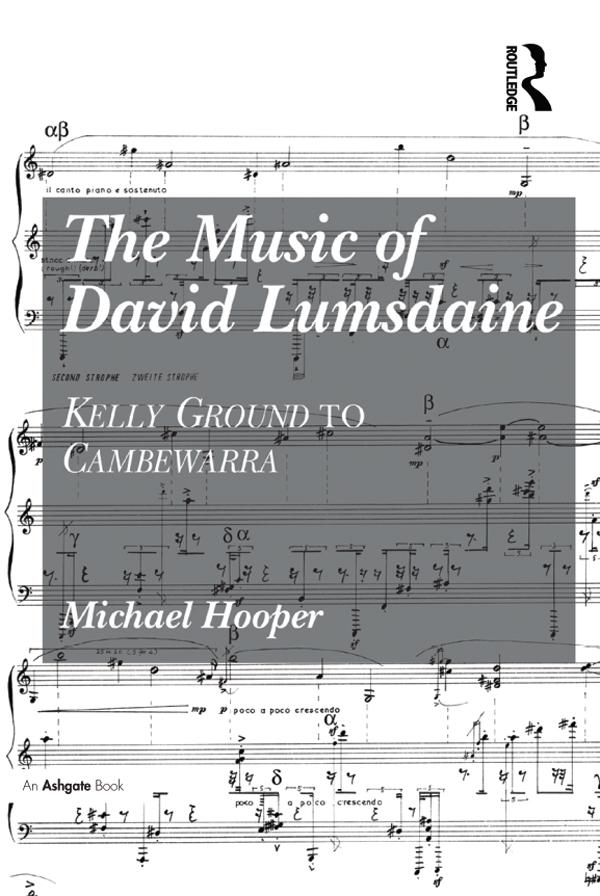
Australian by birth but a longtime resident of Great Britain, David Lumsdaine (b.1931) is central to both Australian and British modernism. During the early 1970s Australian musical modernism was at its height. Lumsdaine and his Australian contemporaries were engaged with practices from multiple places, producing music that displays the attributes of their disparate influences; in so doing they formed a new conception of what it meant to be an Australian composer. The period is similarly important in Britain, for it saw the rise to prominence of composers such as Birtwistle, Davies, Goehr, Gilbert, Wood, Cardew and many others who were Lumsdaine's contemporaries, colleagues and friends. Hooper presents here a series of analyses of Lumsdaine's compositions, focusing on works written between 1966 and 1980. At the early end of this period is Kelly Ground, for solo piano. One of Lumsdaine's first acknowledged works, Kelly Ground connects explicitly with the music of high modernism, employing ideas about temporality as espoused by Ligeti, Stockhausen and Boulez, to form a new ritual for the (now mythical) Australian outlaw Ned Kelly. Hooper places Lumsdaine's music in the context of Australian and British avant-gardes, and reveals its elegance, lyricism and technical virtuosity.
Pay easily by card, Klarna, Apple Pay or Google Pay. Not happy? You always have a 14-day money-back guarantee. Read more in our terms. If you have any questions, email us at hello@memmo.org.
Memmo makes studying easier – wherever you are in the world. We bring your course books and smart study tools together in one place: summaries, quizzes, podcasts and flashcards. Plus Ted, your study buddy who answers anything you wonder. Over 50,000 students already study here – built to help you learn faster and stress less.
You might also like
Buy the book0