
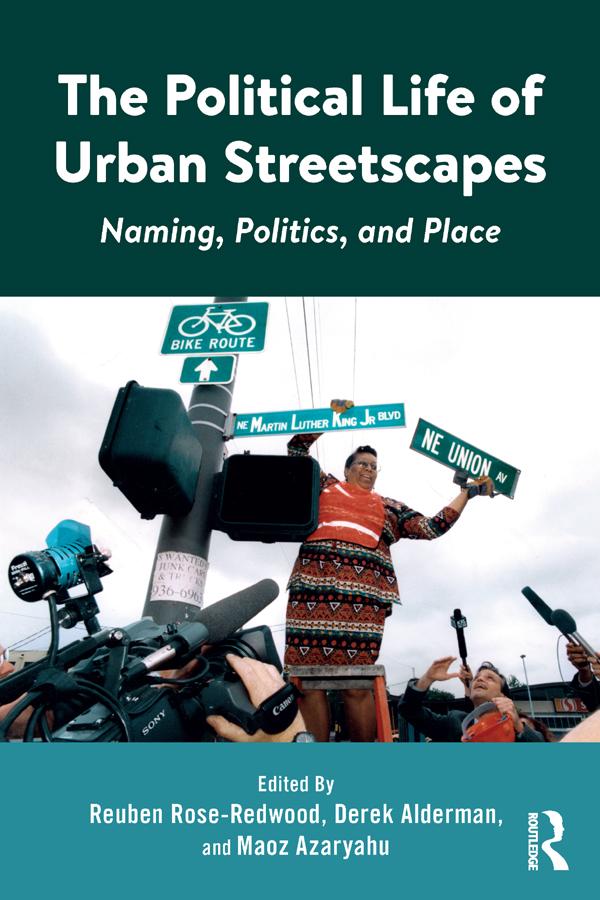
Streetscapes are part of the taken-for-granted spaces of everyday urban life, yet they are also contested arenas in which struggles over identity, memory, and place shape the social production of urban space. This book examines the role that street naming has played in the political life of urban streetscapes in both historical and contemporary cities. The renaming of streets and remaking of urban commemorative landscapes have long been key strategies that different political regimes have employed to legitimize spatial assertions of sovereign authority, ideological hegemony, and symbolic power. Over the past few decades, a rich body of critical scholarship has explored the politics of urban toponymy, and the present collection brings together the works of geographers, anthropologists, historians, linguists, planners, and political scientists to examine the power of street naming as an urban place-making practice. Covering a wide range of case studies from cities in Europe, North America, Sub-Saharan Africa, and Asia, the contributions to this volume illustrate how the naming of streets has been instrumental to the reshaping of urban spatial imaginaries and the cultural politics of place.
Pay easily by card, Klarna, Apple Pay or Google Pay. Not happy? You always have a 14-day money-back guarantee. Read more in our terms. If you have any questions, email us at hello@memmo.org.
Memmo makes studying easier – wherever you are in the world. We bring your course books and smart study tools together in one place: summaries, quizzes, podcasts and flashcards. Plus Ted, your study buddy who answers anything you wonder. Over 75,000 students already study here – built to help you learn faster and stress less.