
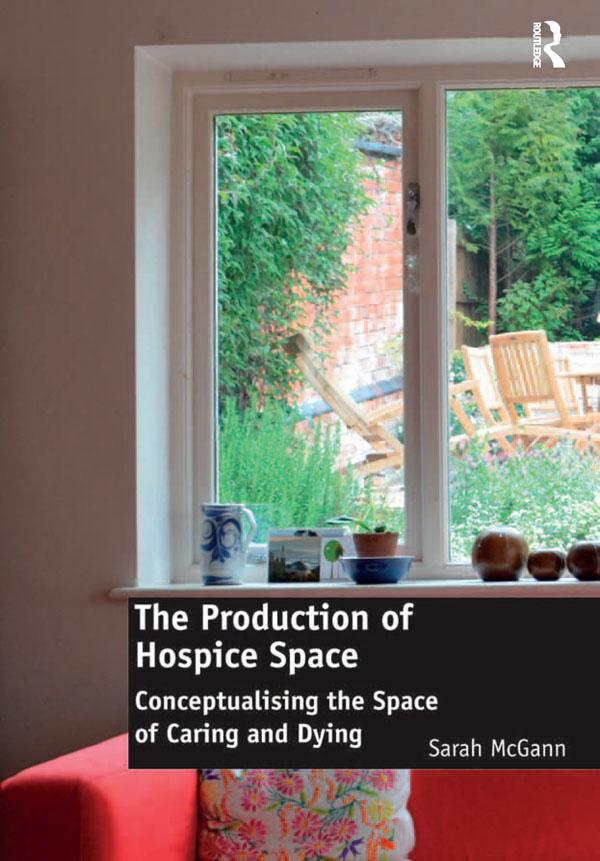
Challenging the widely held notion of a hospice as a building or a place, this book argues that it should instead be a philosophy of care. It proposes that the positive and negative impact that space can have in the pursuit of an ideal such as hospice care has previously been underestimated. Whether it be a purpose-built hospice, part of a hospital, a nursing home or within the home, a hospice is anchored by space and spatial practices, and these spatial practices are critical for a holistic approach to dying with dignity. Such spatial practices are understood as part of a broad architectural, social, conceptual and theoretical process. By linking health, social and architectural theory and establishing conceptual principles, this book defines 'hospice' as a philosophy that is underpinned by space and spatial practice. In putting forward the notion of 'hospice space', removed from the bounds of a specific building type, it suggests that hospice philosophy could and should be available within any setting of choice where the spatial practices support that philosophy, be it home, nursing home, hospice or 'hospice-friendly-hospitals'.
Pay easily by card, Klarna, Apple Pay or Google Pay. Not happy? You always have a 14-day money-back guarantee. Read more in our terms. If you have any questions, email us at hello@memmo.org.
Memmo makes studying easier – wherever you are in the world. We bring your course books and smart study tools together in one place: summaries, quizzes, podcasts and flashcards. Plus Ted, your study buddy who answers anything you wonder. Over 75,000 students already study here – built to help you learn faster and stress less.
You might also like
Buy the book0