
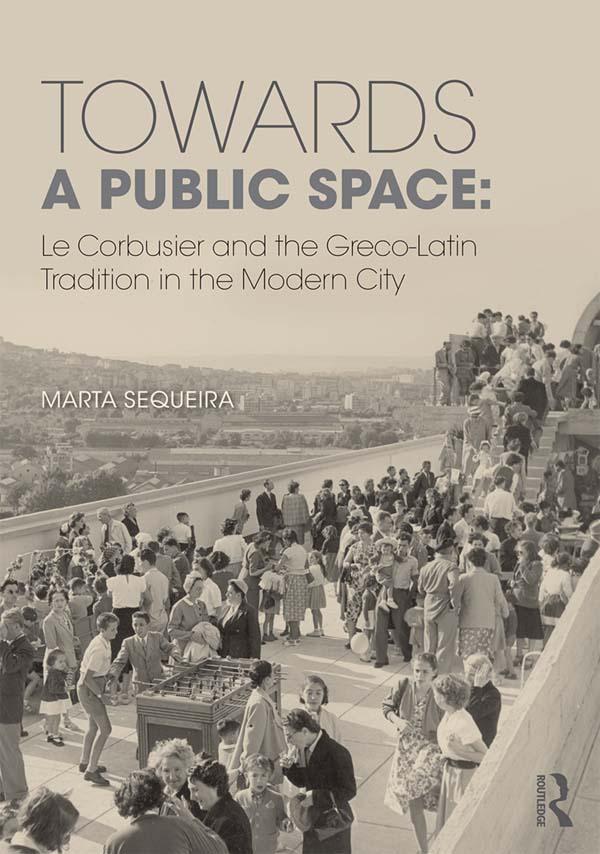
**Selected in the top eight short-list for the Thought and Criticism category of the FAD Awards 2019**
Le Corbusier is well-known for his architectural accomplishments, which have been extensively discussed in literature. Towards a Public Space instead offers a unique analysis of Le Corbusier’s contributions to urban planning.
The public spaces in Le Corbusier’s plans are usually considered to break with the past and to have nothing whatsoever in common with the public spaces created before modernism. This view is fostered by both the innovative character of his proposals and by the proliferation in his manifestos of watchwords that mask any evocation of the past, like l’esprit nouveau ("new spirit") and l’architecture de demain ("architecture of tomorrow"). However, if we manage to rid ourselves of certain preconceived ideas, which underpin a somewhat less-than-objective idea of modernity, we find that Le Corbusier's public spaces not only didn't break with the historical past in any abrupt way but actually testified to the continuity of human creation over time.
Aimed at academics and students in architecture, architectural history and urban planning, this book fills a gap in the systematic analysis of Le Corbusier’s city scale plans and, specifically, Corbusian public spaces following the Second World War.
Pay easily by card, Klarna, Apple Pay or Google Pay. Not happy? You always have a 14-day money-back guarantee. Read more in our terms. If you have any questions, email us at hello@memmo.org.
Memmo makes studying easier – wherever you are in the world. We bring your course books and smart study tools together in one place: summaries, quizzes, podcasts and flashcards. Plus Ted, your study buddy who answers anything you wonder. Over 75,000 students already study here – built to help you learn faster and stress less.