
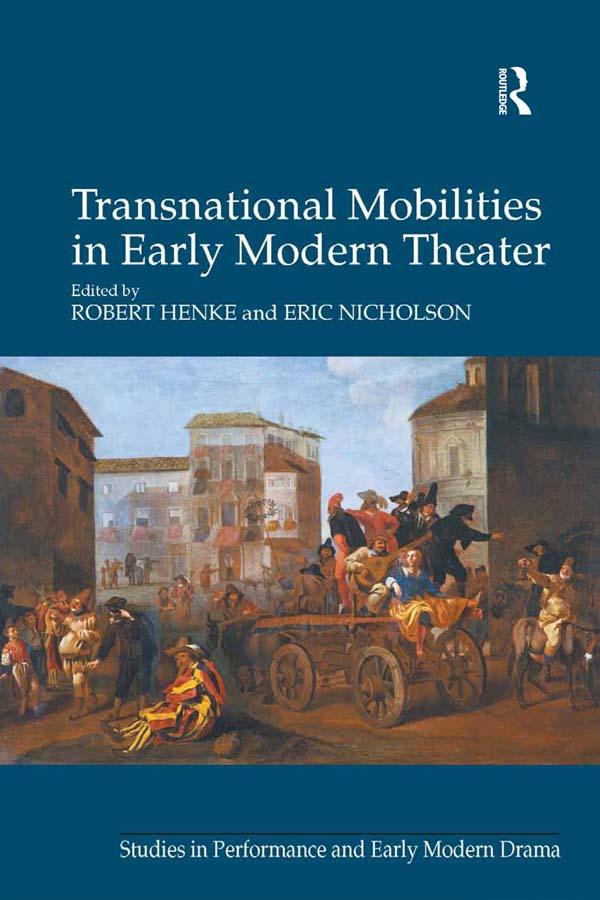
The essays in this volume investigate English, Italian, Spanish, German, Czech, and Bengali early modern theater, placing Shakespeare and his contemporaries in the theatrical contexts of western and central Europe, as well as the Indian sub-continent. Contributors explore the mobility of theatrical units, genres, performance practices, visual images, and dramatic texts across geo-linguistic borders in early modern Europe. Combining 'distant' and 'close' reading, a systemic and structural approach identifies common theatrical units, or 'theatergrams' as departure points for specifying the particular translations of theatrical cultures across national boundaries. The essays engage both 'dramatic' approaches (e.g., genre, plot, action, and the dramatic text) and 'theatrical' perspectives (e.g., costume, the body and gender of the actor). Following recent work in 'mobility studies,' mobility is examined from both material and symbolic angles, revealing both ample transnational movement and periodic resistance to border-crossing. Four final essays attend to the practical and theoretical dimensions of theatrical translation and adaptation, and contribute to the book’s overall inquiry into the ways in which values, properties, and identities are lost, transformed, or gained in movement across geo-linguistic borders.
Pay easily by card, Klarna, Apple Pay or Google Pay. Not happy? You always have a 14-day money-back guarantee. Read more in our terms. If you have any questions, email us at hello@memmo.org.
Memmo makes studying easier – wherever you are in the world. We bring your course books and smart study tools together in one place: summaries, quizzes, podcasts and flashcards. Plus Ted, your study buddy who answers anything you wonder. Over 75,000 students already study here – built to help you learn faster and stress less.
You might also like
Buy the book0