
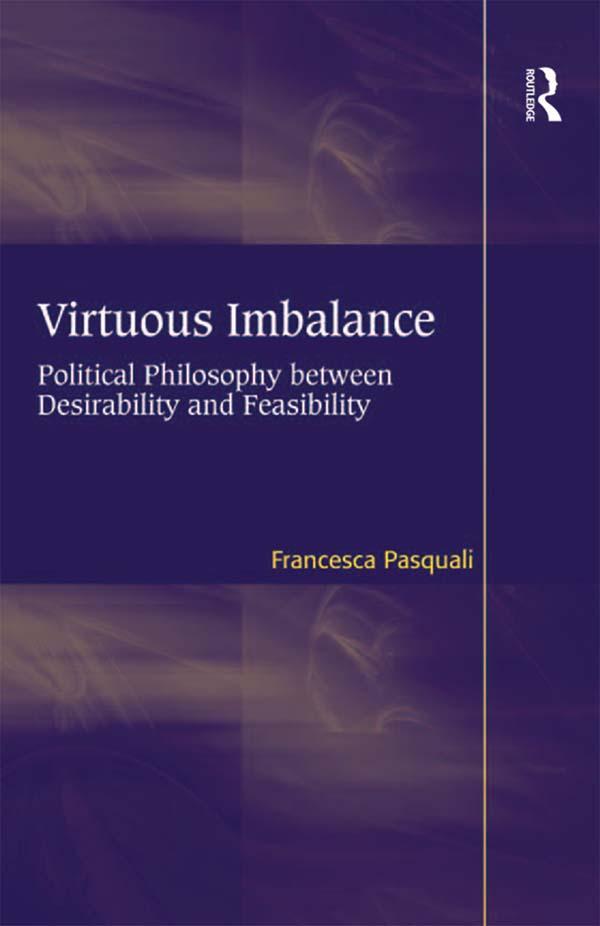
Which kind of methodology should political philosophy endorse to jointly meet its theoretical and practical commitments? Virtuous Imbalance: Political Philosophy between Desirability and Feasibility assesses three paradigmatic cases to explore and explain political philosophy's attempts to answer this important question. Rawls's realistic utopianism, Machiavelli's realism, and Plato's utopianism are examined and explored as Francesca Pasquali presents the proper methodology political philosophy should endorse when attempting to attain equilibrium between the practical and the theoretical. These models are investigated with reference to desirability and feasibility; the former concerning the adequacy of normative principles, the latter the practical possibility of enacting them. Both realism and utopianism are shown to perform important and relevant functions with utopianism providing the criteria for judging political practices and realism developing principles for orienting political actors' conduct. An innovative version of realistic utopianism develops, avoiding the shortfalls detected in previous formulations whilst presenting a methodological strategy that enables political philosophy to play a proper public role, without dismissing theoretical concerns.
Pay easily by card, Klarna, Apple Pay or Google Pay. Not happy? You always have a 14-day money-back guarantee. Read more in our terms. If you have any questions, email us at hello@memmo.org.
Memmo makes studying easier – wherever you are in the world. We bring your course books and smart study tools together in one place: summaries, quizzes, podcasts and flashcards. Plus Ted, your study buddy who answers anything you wonder. Over 50,000 students already study here – built to help you learn faster and stress less.
You might also like
Buy the book0