
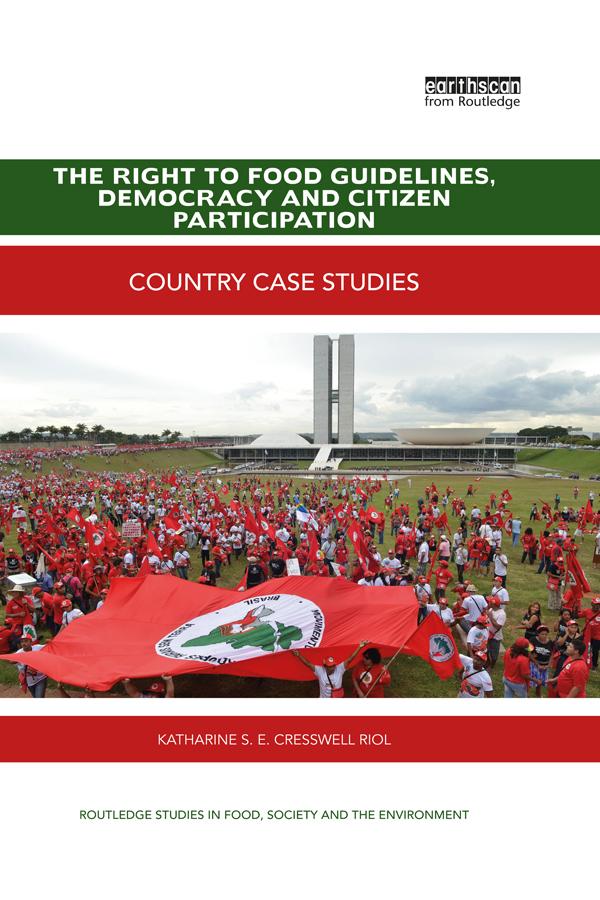
It is now more than a decade since the Right to Food Guidelines were negotiated, agreed and adopted internationally by states. This book provides a review of its objectives and the extent of success of its implementation. The focus is on the first key guideline – "Democracy, good governance, human rights and the rule of law" – with an emphasis on civil society participation in global food governance. The five BRICS countries (Brazil, Russia, India, China and South Africa) are presented as case studies: representing major emerging economies, they blur the line between the Global North and South, and exhibit different levels of human rights realisation.
The book first provides an overview of the right to adequate food, accountability and democracy, and an introduction to the history of the development of the right to adequate food and the Right to Food Guidelines. It presents a historical synopsis of each of the BRICS states’ experiences with the right to adequate food and an analysis of their related periodic reporting to the Committee on Economic, Social and Cultural Rights, as well as a specific assessment of their progress in regard to the first guideline. The discussion then focuses on the effectiveness of the Right to Food Guidelines as both a policy-making and monitoring tool, based on the analysis of the guidelines and the BRICS states.
Pay easily by card, Klarna, Apple Pay or Google Pay. Not happy? You always have a 14-day money-back guarantee. Read more in our terms. If you have any questions, email us at hello@memmo.org.
Memmo makes studying easier – wherever you are in the world. We bring your course books and smart study tools together in one place: summaries, quizzes, podcasts and flashcards. Plus Ted, your study buddy who answers anything you wonder. Over 50,000 students already study here – built to help you learn faster and stress less.