
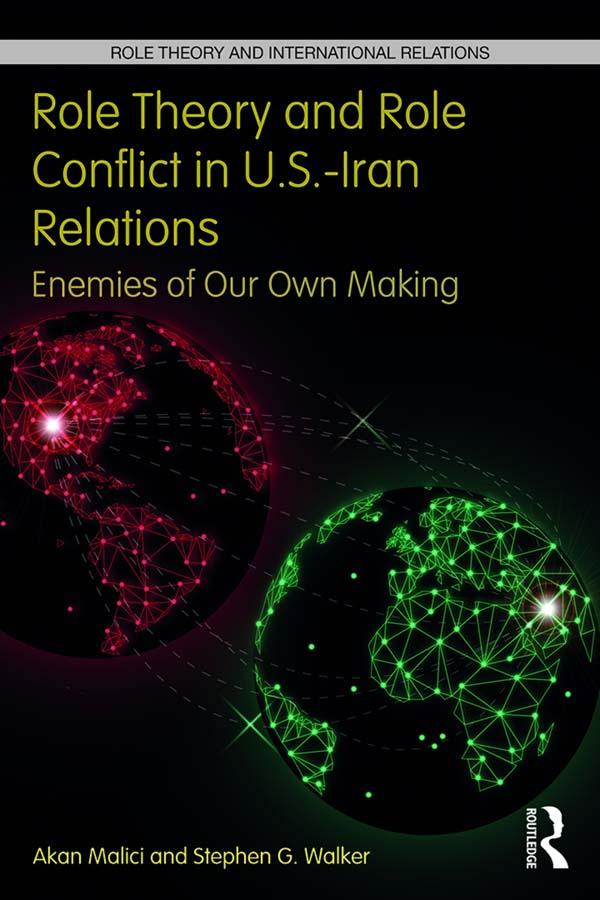
U.S.-Iran relations continue to be an international security problem in the Middle East. These two countries could have been friends, but instead they have become enemies. Stating this thesis raises the following questions: Why are the United States and Iran enemies? How and when did this relationship come to be? When the relationship began to deteriorate, could it have been reversed? What lessons can be learned from an analysis of past U.S.-Iranian relations and what are the implications for their present and future relations?
Akan Malici and Stephen G. Walker argue that the dynamics of U.S.-Iran relations are based on role conflicts. Iran has long desired to enact roles of active independence and national sovereignty in world politics. However, it continued to be cast by others into client or rebel roles of national inferiority. In this book the authors examine these role conflicts during three crucial episodes in U.S.-Iran relations: the oil nationalization crisis and the ensuing clandestine coup aided by the CIA to overthrow the Iranian regime in 1950 to 1953; the Iranian revolution followed by the hostage crisis in 1979 to 1981; the reformist years pre- and post- 9/11 under Mohammad Khatami from 1997 to 2002. Their application of role theory is theoretically and methodologically progressive and innovative in illuminating aspects of U.S.-Iran relations. It allows for a better understanding of the past, navigating the present, and anticipating the future in order to avoid foreign policy mistakes.
Role Theory and Role Conflict in U.S.-Iran Relations is a useful resource for international relations and foreign policy scholars who want to learn more about progress in international relations theory and U.S. relations with Iran.
Pay easily by card, Klarna, Apple Pay or Google Pay. Not happy? You always have a 14-day money-back guarantee. Read more in our terms. If you have any questions, email us at hello@memmo.org.
Memmo makes studying easier – wherever you are in the world. We bring your course books and smart study tools together in one place: summaries, quizzes, podcasts and flashcards. Plus Ted, your study buddy who answers anything you wonder. Over 50,000 students already study here – built to help you learn faster and stress less.