
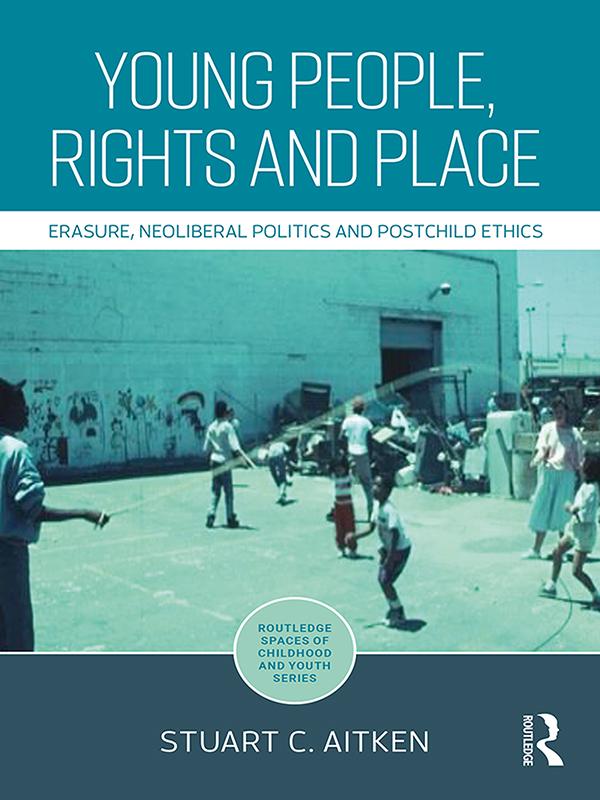
Concern is growing about children’s rights and the curtailment of those rights through the excesses of neoliberal governance. This book discusses children’s spatial and citizenship rights, and the ways young people and their families push against diminished rights.
Armed initially with theoretical concerns about the construction of children through the political status quo and the ways youth rights are spatially segregated, the book begins with a disarmingly simple supposition: Young people have the right to make and remake their spaces and, as a consequence, themselves. This book de-centers monadic ideas of children in favor of a post-humanist perspective, which embraces the radical relationality of children as more-than-children/more-than-human. Its empirical focus begins with the struggles of Slovenian Izbrisani (‘erased’) youth from 1992 to the present day and reaches out to child rights and youth activists elsewhere in the world with examples from South America, Eastern Europe and the USA. The author argues that universal child rights have not worked and pushes for a more radical, sustainable ethics, which dares to admit that children’s humanity is something more than we, as adults, can imagine.
Chapters in this groundbreaking contribution will be of interest to students, researchers and practitioners in the social sciences, humanities and public policy.
Pay easily by card, Klarna, Apple Pay or Google Pay. Not happy? You always have a 14-day money-back guarantee. Read more in our terms. If you have any questions, email us at hello@memmo.org.
Memmo makes studying easier – wherever you are in the world. We bring your course books and smart study tools together in one place: summaries, quizzes, podcasts and flashcards. Plus Ted, your study buddy who answers anything you wonder. Over 50,000 students already study here – built to help you learn faster and stress less.