
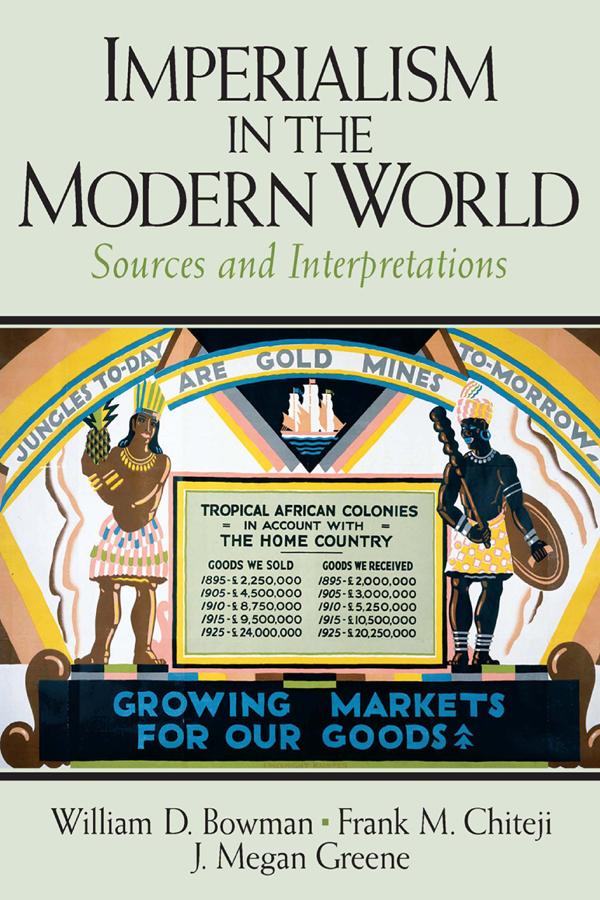
Imperialism in the Modern World combines narrative, primary and secondary sources, and visual documents to examine global relations in the nineteenth and twentieth centuries.
The three co-editors, Professors Bowman, Chiteji, and Greene, have taught for many years global history classes in a variety of institutions. They wrote Imperialism in the Modern World to solve the problem of allowing teachers to combine primary and secondary texts easily and systematically to follow major themes in global history (some readers use primary materials exclusively. Some focus on secondary arguments). This book is more focused than other readers on the markets for those teachers who are offering more specialized world history courses - one important trend in global history is away from simply trying to cover everything to teaching real connections in more chronologically and thematically focused courses. The reader also provides a genuine diversity of global perspectives and invites students to study seriously world history from a critical framework. Too many readers offer a smorgasbord approach to world history that leaves students dazed and confused. This reader avoids that approach and will therefore solve many problems that teachers have in constructing and teaching world history courses at the introductory or upper-division levels. The reader will allow show students how to read historical documents through a hands-on demonstration in the introduction. The book also incorporates images as visual documents. Finally, the book conceives of global history in the widest possible terms; it contains pieces on political, diplomatic, economic, and military history, to be sure, but it also has selections on technology, medicine, women, the environment, social changes, and cultural patterns. Other readers can not match this text's breadth because they are chronologically and thematically so extended.
Pay easily by card, Klarna, Apple Pay or Google Pay. Not happy? You always have a 14-day money-back guarantee. Read more in our terms. If you have any questions, email us at hello@memmo.org.
Memmo makes studying easier – wherever you are in the world. We bring your course books and smart study tools together in one place: summaries, quizzes, podcasts and flashcards. Plus Ted, your study buddy who answers anything you wonder. Over 50,000 students already study here – built to help you learn faster and stress less.