
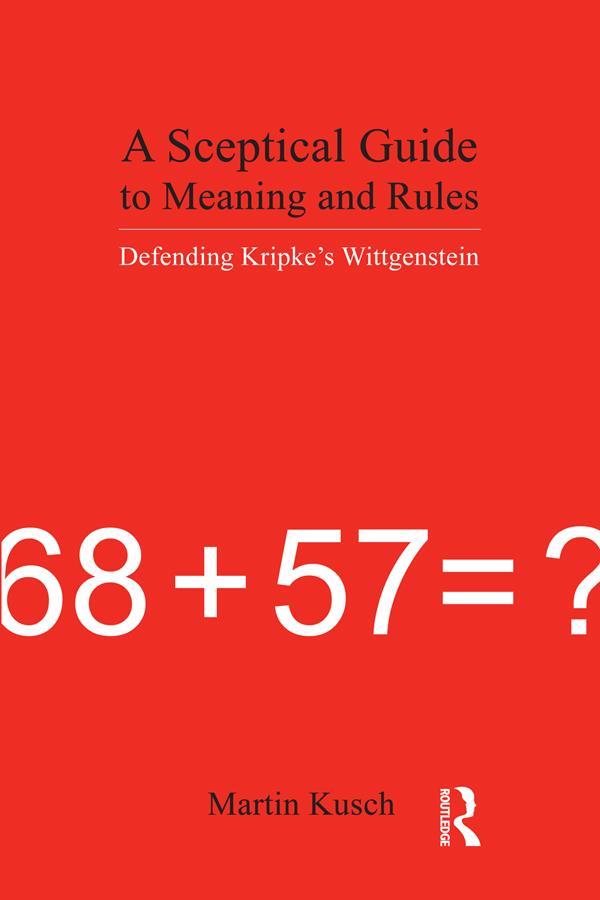
No other recent book in Anglophone philosophy has attracted as much criticism and has found so few friends as Saul Kripke's "Wittgenstein on Rules and Private Language". Amongst its critics, one finds the very top of the philosophical profession. Yet, it is rightly counted amongst the books that students of philosophy, at least in the Anglo-American world, have to read at some point in their education. Enormously influential, it has given rise to debates that strike at the very heart of contemporary philosophy of mind and language. In this major new interpretation, Martin Kusch defends Kripke's account against the numerous weighty objections that have been put forward over the past twenty years and argues that none of them is decisive. He shows that many critiques are based on misunderstandings of Kripke's reasoning; that many attacks can be blocked by refining and developing Kripke's position; and that many alternative proposals turn out either to be unworkable or to be disguised variants of the view they are meant to replace. Kusch argues that the apparent simplicity of Kripke's text is deceptive and that a fresh reading gives Kripke's overall argument a new strength.
Pay easily by card, Klarna, Apple Pay or Google Pay. Not happy? You always have a 14-day money-back guarantee. Read more in our terms. If you have any questions, email us at hello@memmo.org.
Memmo makes studying easier – wherever you are in the world. We bring your course books and smart study tools together in one place: summaries, quizzes, podcasts and flashcards. Plus Ted, your study buddy who answers anything you wonder. Over 50,000 students already study here – built to help you learn faster and stress less.
You might also like
Buy the book0