
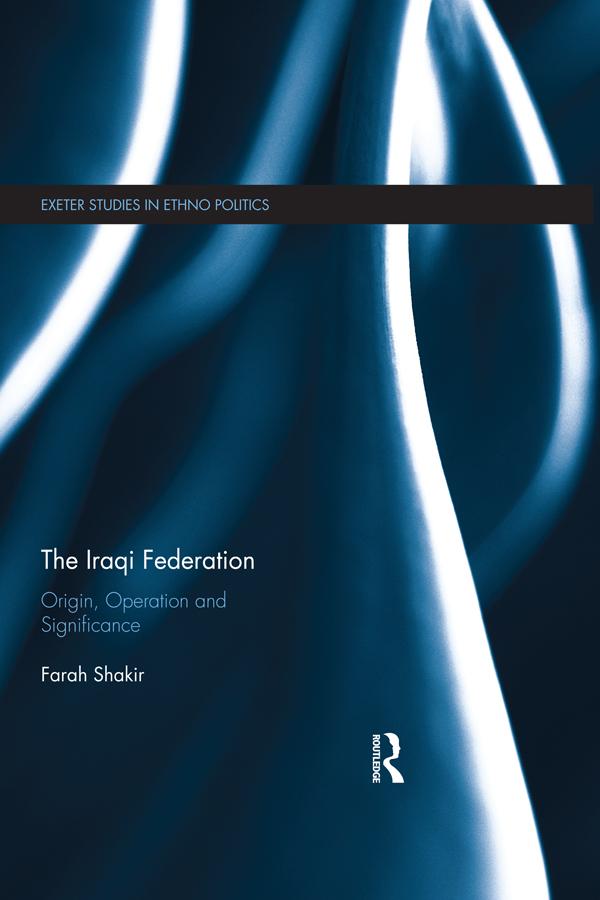
Political instability has characterised the modern history of Iraq, which has proven itself as a complex state to govern. However, the creation of a federal system in 2005 offers the potential for change and a deviation from a past characterised by authoritarian government, brutality and war.
The Iraqi Federation explores why and how Iraq became a federal state, and analyses how the process of formation impacts on the operation of the Iraqi federal system. It argues that the different approaches taken by various federal theorists in the past, particularly William H. Riker’s bargain theory, are insufficient to explain the formation of the Iraqi federation completely. The process of the establishment of a federal Iraq must be understood in the context of its unique history and cultural specificity, as well as in the context of the other new federal models that have appeared since the end of the Cold War, including Belgium, the Russian Federation, Ethiopia, Bosnia and Herzegovina and Nigeria.
Drawing on interviews with contemporary political players in Iraq, this book helps to deepen our understanding of how one of the newest federal states operates in a practical sense. By linking the new federal models to the classic federal theory, it also provides a unique contribution to theories on federal state formation. It will therefore be of great interest to students and scholars of Middle East Politics, as well as those studying Federalism.
Pay easily by card, Klarna, Apple Pay or Google Pay. Not happy? You always have a 14-day money-back guarantee. Read more in our terms. If you have any questions, email us at hello@memmo.org.
Memmo makes studying easier – wherever you are in the world. We bring your course books and smart study tools together in one place: summaries, quizzes, podcasts and flashcards. Plus Ted, your study buddy who answers anything you wonder. Over 50,000 students already study here – built to help you learn faster and stress less.