
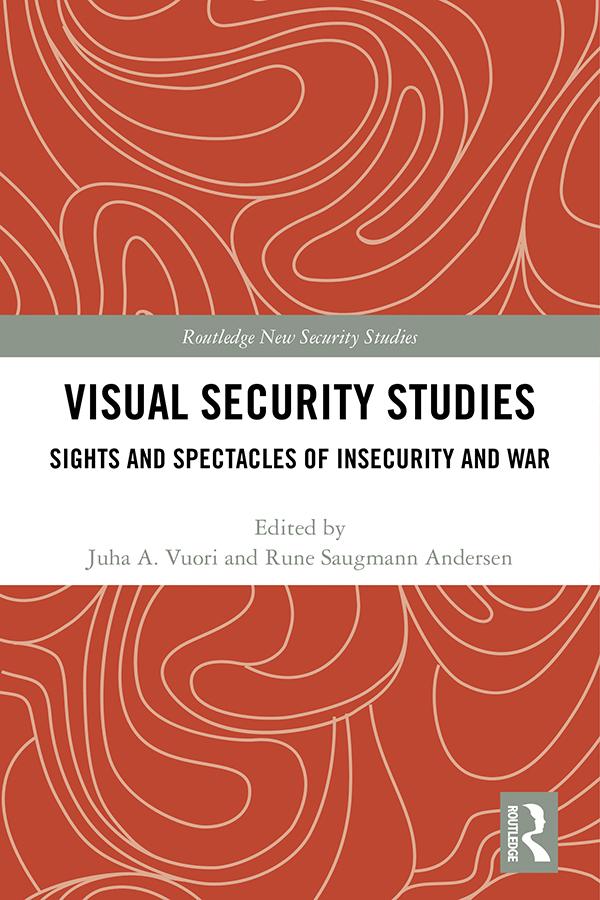
The present volume engages visuality in security from a variety of angles and explores what the subfield of Visual Security Studies might be.
To structure this experimentation, and to encourage a more careful and multifaceted approach to visuality and security, the main conceptual move in this volume is to envision three different transversal meeting points between security and visuality: visuality as a modality (active in representations and signs of security), visuality as practice (active in enacting security), and visuality as a method (active in investigating security). These three approaches structure the book together with three areas in which we see visuality as especially pertinent in relation to security: in security technologies that (en)vision security and are themselves the objects of visions of security; in spectacles of security and security spectatorship; and in ways of making security visible.
In this way, the volume works to sensitize International Relations research to visual forms of knowledge and practice by examining visual aspects of security. At the same time, it allows for debate on how this particular modality of the sensible not only affects what is visible and what is not, but also how authority and truth-claims come about, and how they are compared and evaluated. Through engagement with security via the ‘language’ or ‘code’ of the visual, it is possible to interrogate how scholars in the field understand visuality as well as the economy, grammar, and performativity of visual articulation and the production of knowledge. The volume also examines how visuality can be used as a method in doing research, and as a way of presenting research results.
Visual Security Studies is not a new theory of security or its study; instead, the present volume suggests that visuality should be envisioned as an aspect of security studies that can be incorporated into pre-existing approaches. The aim is to highlight how much of contemporary practice is visual and to foster an increased attentiveness to visuality in security politics, security practice, and to the possibilities of employing visual research methods in security scholarship.
This book will be of much interest to students of critical security, media studies, surveillance studies, visual sociology, and IR in general.
Pay easily by card, Klarna, Apple Pay or Google Pay. Not happy? You always have a 14-day money-back guarantee. Read more in our terms. If you have any questions, email us at hello@memmo.org.
Memmo makes studying easier – wherever you are in the world. We bring your course books and smart study tools together in one place: summaries, quizzes, podcasts and flashcards. Plus Ted, your study buddy who answers anything you wonder. Over 50,000 students already study here – built to help you learn faster and stress less.