
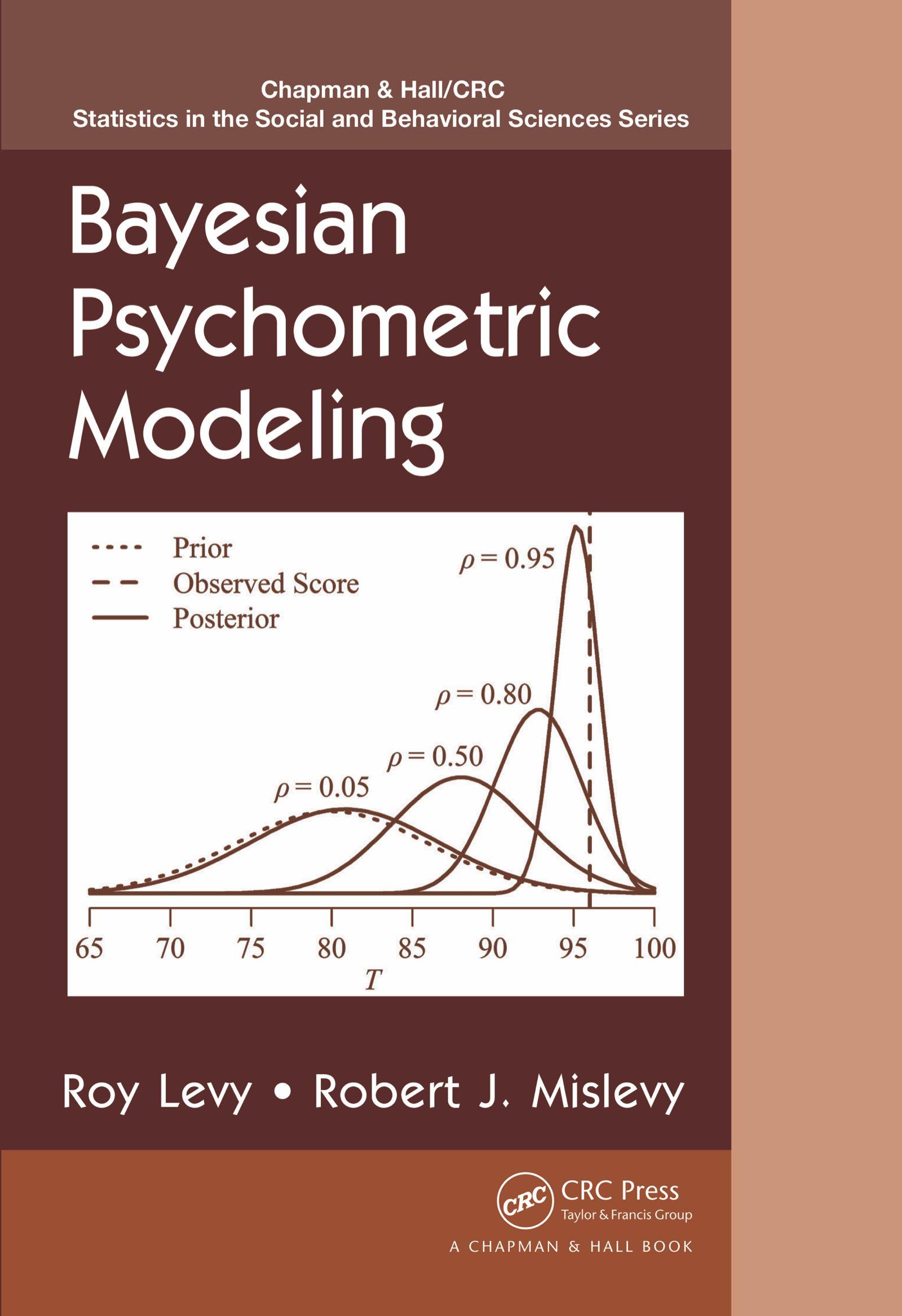
A Single Cohesive Framework of Tools and Procedures for Psychometrics and Assessment
Bayesian Psychometric Modeling presents a unified Bayesian approach across traditionally separate families of psychometric models. It shows that Bayesian techniques, as alternatives to conventional approaches, offer distinct and profound advantages in achieving many goals of psychometrics.
Adopting a Bayesian approach can aid in unifying seemingly disparate—and sometimes conflicting—ideas and activities in psychometrics. This book explains both how to perform psychometrics using Bayesian methods and why many of the activities in psychometrics align with Bayesian thinking.
The first part of the book introduces foundational principles and statistical models, including conceptual issues, normal distribution models, Markov chain Monte Carlo estimation, and regression. Focusing more directly on psychometrics, the second part covers popular psychometric models, including classical test theory, factor analysis, item response theory, latent class analysis, and Bayesian networks. Throughout the book, procedures are illustrated using examples primarily from educational assessments. A supplementary website provides the datasets, WinBUGS code, R code, and Netica files used in the examples.
Pay easily by card, Klarna, Apple Pay or Google Pay. Not happy? You always have a 14-day money-back guarantee. Read more in our terms. If you have any questions, email us at hello@memmo.org.
Memmo makes studying easier – wherever you are in the world. We bring your course books and smart study tools together in one place: summaries, quizzes, podcasts and flashcards. Plus Ted, your study buddy who answers anything you wonder. Over 75,000 students already study here – built to help you learn faster and stress less.