
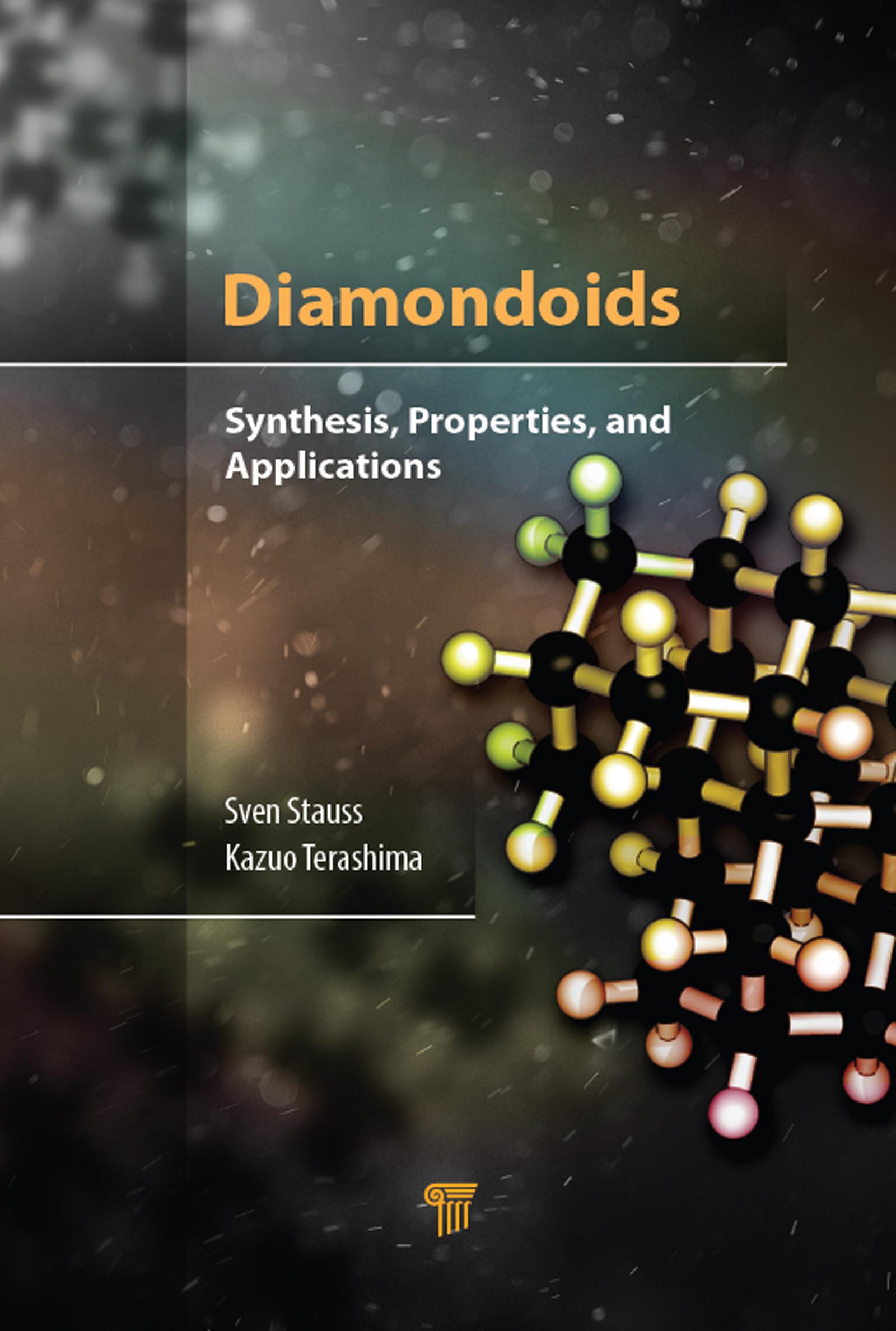
Over the past few decades, carbon nanomaterials, most commonly fullerenes, carbon nanotubes, and graphene, have gained increasing interest in both science and industry, due to their advantageous properties that make them attractive for many applications in nanotechnology. Another class of the carbon nanomaterials family that has slowly been gaining (re)newed interest is diamond molecules, also called diamondoids, which consist of polycyclic carbon cages that can be superimposed on a cubic diamond lattice. Derivatives of diamondoids are used in pharmaceutics, but due to their promising properties—well-defined structures, high thermal and chemical stability, negative electron affinity, and the possibility to tune their bandgap—diamondoids could also serve as molecular building blocks in future nanodevices.
This book is the first of its kind to give an exhaustive overview of the structures, properties, and current and possible future applications of diamondoids. It contains a brief historical account of diamondoids, from the discovery of the first diamondoid member, adamantane, to the isolation of higher diamondoids about a decade ago. It summarizes the different approaches to synthesizing diamondoids. In particular, current research on the conventional organic synthesis and new approaches based on microplasmas generated in high-pressure and supercritical fluids are reviewed and the advantages and disadvantages of the different methods discussed. The book will serve as a reference for advanced undergraduate- and graduate-level students in chemistry, physics, materials science, and nanotechnology and researchers in macromolecular science, nanotechnology, chemistry, biology, and medicine, especially those with an interest in nanoparticles.
Pay easily by card, Klarna, Apple Pay or Google Pay. Not happy? You always have a 14-day money-back guarantee. Read more in our terms. If you have any questions, email us at hello@memmo.org.
Memmo makes studying easier – wherever you are in the world. We bring your course books and smart study tools together in one place: summaries, quizzes, podcasts and flashcards. Plus Ted, your study buddy who answers anything you wonder. Over 75,000 students already study here – built to help you learn faster and stress less.