
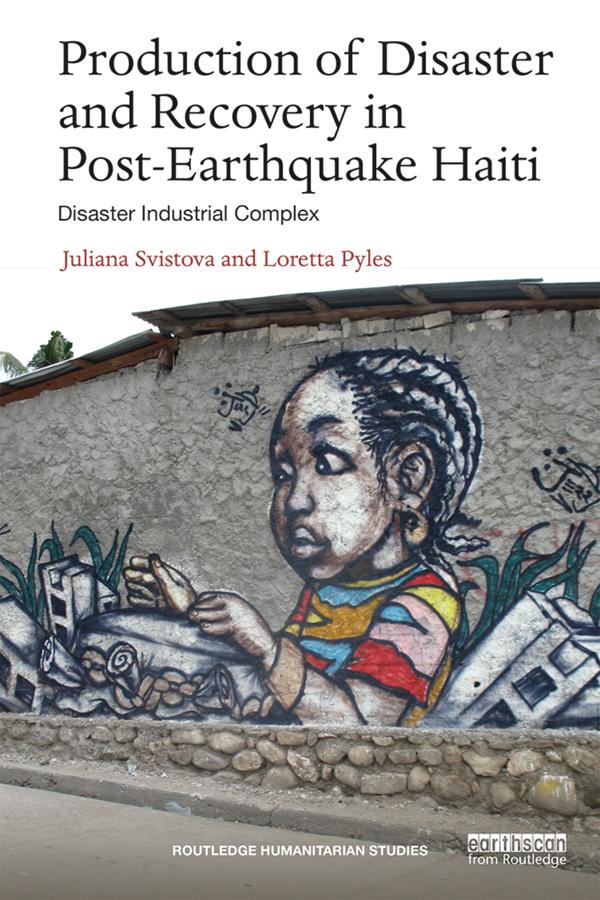
Natural disasters have long been seen as naturally generated events, but as scientific, technological, and social knowledge of disasters has become more sophisticated, the part that people and systems play in disaster events has become more apparent. Production of Disaster and Recovery in Post-Earthquake Haiti demonstrates how social processes impact disasters as they unfold, through the distribution of power and resources, the use of discourses and images of disaster, and the economic and social systems and relations which underlie affected communities. The authors show how these processes played out in post-earthquake Haiti to set in motion the mechanics of the disaster industrial complex to (re)produce disasters and recovery rather than bring sustainable change.
The book reveals that disaster and recovery rhetoric helped create fertile conditions for neoliberal disaster governance, militarized and digital humanitarianism, non-profiteering, and disaster opportunism to flourish while further disenfranchising marginalized populations. However, the Haiti earthquake, as is the case with all disaster sites, was ripe with mutual aid, community building, and collective action, all of which further local resilience. The authors seek to re-construct dominant discourses, policies, and practices to advance equitable, participatory partnerships with local community actors and propose a praxis for a people’s recovery as an action-oriented framework for resisting the transnational disaster industrial machinery. The authors argue for new synergies in policymaking and program development that can respond to emergencies and plan for true long-term, sustainable development after disasters that focuses as much on humans and the natural world as it does on economic progress.
Production of Disaster and Recovery in Post-Earthquake Haiti will be of great interest to students and scholars of disaster studies, humanitarian studies, development studies, Haitian studies, geography and environmental studies, as well as to non-governmental organizations, humanitarians, and policymakers.
Pay easily by card, Klarna, Apple Pay or Google Pay. Not happy? You always have a 14-day money-back guarantee. Read more in our terms. If you have any questions, email us at hello@memmo.org.
Memmo makes studying easier – wherever you are in the world. We bring your course books and smart study tools together in one place: summaries, quizzes, podcasts and flashcards. Plus Ted, your study buddy who answers anything you wonder. Over 50,000 students already study here – built to help you learn faster and stress less.