
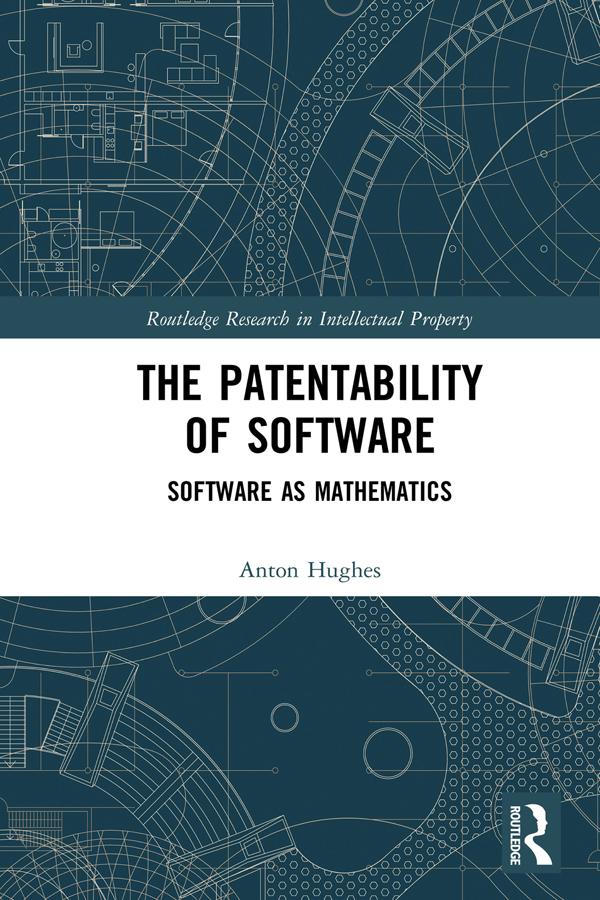
This book explores the question of whether software should be patented. It analyses the ways in which the courts of the US, the EU, and Australia have attempted to deal with the problems surrounding the patentability of software and describes why it is that the software patent issue should be dealt with as a patentable subject matter issue, rather than as an issue of novelty or nonobviousness.
Anton Hughes demonstrates that the current approach has failed and that a fresh approach to the software patent problem is needed. The book goes on to argue against the patentability of software based on its close relationship to mathematics. Drawing on historical and philosophical accounts of mathematics in pursuit of a better understanding of its nature and focusing the debate on the conditions necessary for mathematical advancement, the author puts forward an analytical framework centred around the concept of the useful arts. This analysis both explains mathematics’, and therefore software’s, nonpatentability and offers a theory of patentable subject matter consistent with Australian, American, and European patent law.
Pay easily by card, Klarna, Apple Pay or Google Pay. Not happy? You always have a 14-day money-back guarantee. Read more in our terms. If you have any questions, email us at hello@memmo.org.
Memmo makes studying easier – wherever you are in the world. We bring your course books and smart study tools together in one place: summaries, quizzes, podcasts and flashcards. Plus Ted, your study buddy who answers anything you wonder. Over 50,000 students already study here – built to help you learn faster and stress less.