
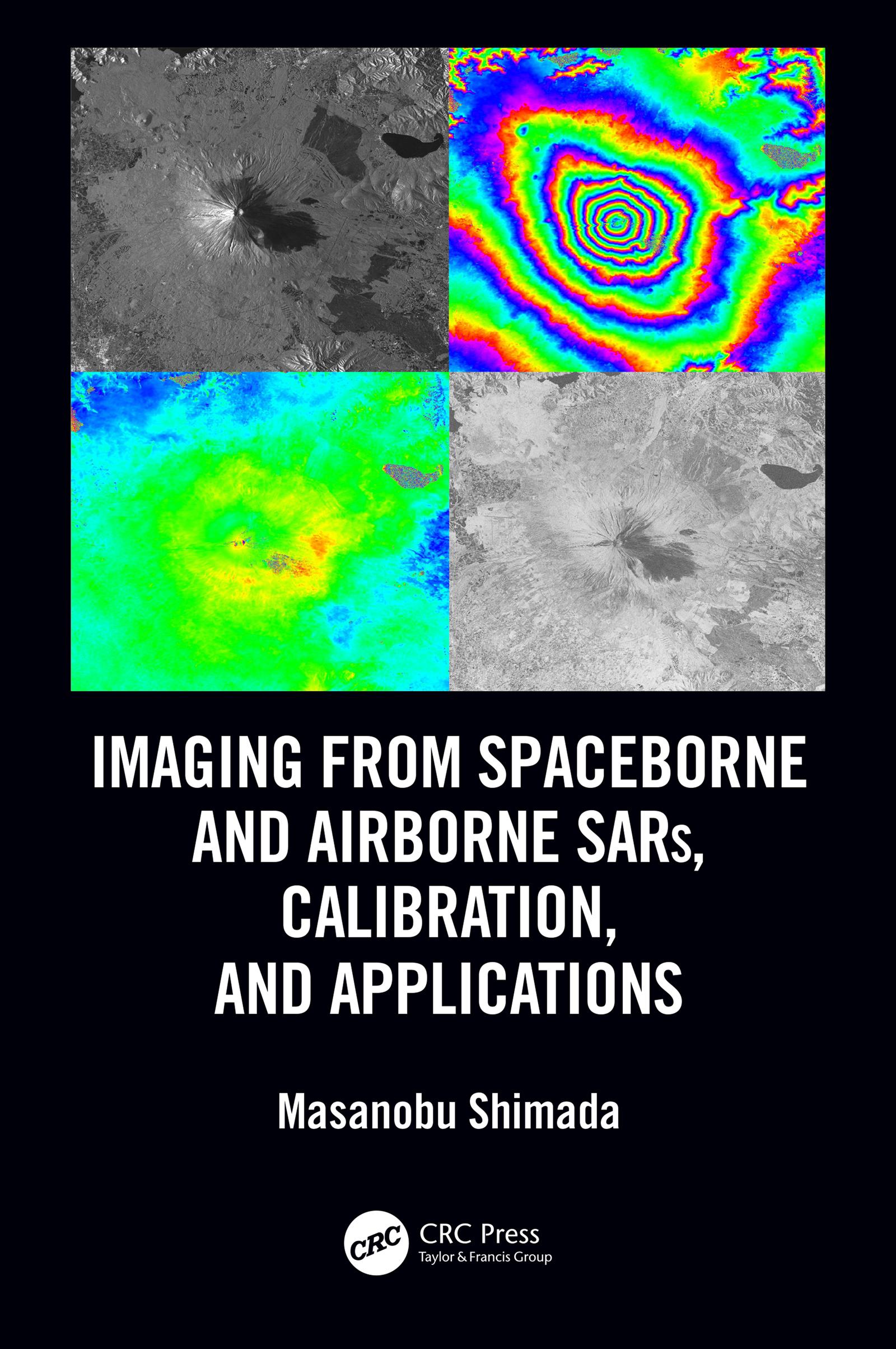
Sixty years after its birth, Synthetic Aperture Radar (SAR) evolved as a key player of earth observation, and it is continually upgraded by enhanced hardware functionality and improved overall performance in response to user requirements. The basic information gained by SAR includes the backscattering coefficient of targets, their phases (the truncated distance between SAR and its targets), and their polarization dependence. The spatiotemporal combination of the multiple data operated on the satellite or aircraft significantly increases its sensitivity to detect changes on earth, including temporal variations of the planet in amplitude and the interferometric change for monitoring disasters; deformations caused by earthquakes, volcanic activity, and landslides; environmental changes; ship detection; and so on. Earth-orbiting satellites with the appropriate sensors can detect environmental changes because of their large spatial coverage and availability.
Imaging from Spaceborne and Airborne SARs, Calibration, and Applications provides A-to-Z information regarding SAR researches through 15 chapters that focus on the JAXA L-band SAR, including hardware description, principles of SAR imaging, theoretical description of SAR imaging and error, ScanSAR imaging, polarimetric calibration, inflight antenna pattern, SAR geometry and ortho rectification, SAR calibration, defocusing for moving targets, large-scale SAR imaging and mosaic, interferometric SAR processing, irregularities, application, and forest estimation. Sample data are created by using L-band SAR, JERS-1, PALSAR, PALSAR-2, and Pi-SAR-L2.
This book is based on the author’s experience as a principal researcher at JAXA with responsibilities for L-band SAR operation and researches. It reveals the inside of SAR processing and application researches performed at JAXA, which makes this book a valuable reference for a wide range of SAR researchers, professionals, and students.
Pay easily by card, Klarna, Apple Pay or Google Pay. Not happy? You always have a 14-day money-back guarantee. Read more in our terms. If you have any questions, email us at hello@memmo.org.
Memmo makes studying easier – wherever you are in the world. We bring your course books and smart study tools together in one place: summaries, quizzes, podcasts and flashcards. Plus Ted, your study buddy who answers anything you wonder. Over 50,000 students already study here – built to help you learn faster and stress less.